Welcome to the Revolution

Hi there, welcome to my blog - La Revolution Deux. It's an odd name - but I like it! Here you will find all the info on my various DIY Guitar effects builds, amplifiers and guitars. Everything from a humble Ibanez tubescreamer to the holiest KLON Overdrive.

You may also find a few effects builds that I am looking to move on - usually in exchange for other effects/gear/cash. You can always check my ebay account to see what I've got up for grabs.

Have fun, enjoy the blog - Fred Briggs :-)

CONTACT ME


Feel free to get in contact with me about anything you see on this blog or with any general questions about guitars, amplifiers and effects, I'll be happy to answer! Just click the button above to email me directly or alternately my email address is fredbriggs2007 [at] googlemail [dot] com

Search This Blog

Monday, 23 July 2012

Wampler - Ecstasy / Euphoria Overdrive


The Wampler Ecstasy has recently been renamed the "Euphoria", for what reasons I'm unsure but it could be to do with a few not-so-positive forum topics popping up on google when you search for Wampler Ecstasy! I thought I'd already covered this one but a quick trip over to IVIark's tagboardeffects.blogspot.com reminded me that I haven't! The general circuit topology has been known for a while after Brian Wampler kindly got stuck in and posted a few hints over at the freestompboxes.org forum;

"Here's the thinking along the design of the ecstasy. The idea was to boost the bass to fuzz up the bottom end a bit, yet retain soft clipping. So there's a pot to a big cap (nfb to ground), variable low pass filter as a tone control, simple gain boost opamp stage after this. [The] switch adds in diodes to 4.5v ref (IIRC!), soft clipping only, or no diodes which is all opamp clipping. Simple design, but works and sounds great."

Gutshot of the Wampler Ecstasy Overdrive
So let's have a read of the description of the Ecstasy / Euphoria from the Wampler website;

"When Brian created the circuit that would eventually become the Euphoria, he was working on creating a pedal that would go from clean tones to distorted tones while adding a bit of warmth. He wanted something for himself that would be dynamic, have a great sounding “gritty” tone to it yet be able to respond to the volume knob like a tube amp. Everything about Brian is in the dynamics of sound and if a pedal can't work with him dynamically, then he just can't use it.

The Euphoria is his take on that elusive tone and feel made famous by Dumble Amplifiers - smooth creaminess yet crunchy when you need it to be, yet the tonality is much more transparent than other “dumble sounding" pedals. Very responsive tone controls that interact with the pedal - they don't just “color” the sound. The controls actually affect the response and feel of the pedal, just like a great tube amp.

If you love the sound of your clean tone, and just wish you could have more “hair” on the note... a little bit of grit without any change in tonality, the Euphoria will do that with ease. PLUS it's extremely flexible... with the toggle switch in the down position you'll get a hint of fuzz along with the overdrive, it's reminiscent of the tones that "Eric Johnson" may use. With the toggle in the up position the tonality is super smooth, creamy yet crunchy when you dig into the strings.

This is reminiscent to the famous “Dumble” tone, though it's really much, much more than that. In the center position, the toggle will give you tons of crunch, or roll the gain back a bit and push the volume up and you have a superior clean boost with a 2 band EQ that's extremely transparent, but variable so you can actually turn it into an awesome treble booster just by cranking up the treble and turning the bass down."

Here's a ProGuitarShop demo video of the Ecstasy / Euphoria in action;


Now we've heard it lets see the reversed schematic;


Note that the schematic is a screen grab from modelling software - you don't need the three seperate voltage dividers which provide 4.5v, a single voltage divider will do with all of the points that need connecting to 4.5v pointed there. the 12.5k/12.5k resistors in the filter at the rear of the circuit are in fact a 25k pot with it's middle lug connected to the 22nF cap. The opamp (as seen in the gutshot above) is a JRC4580D.

So looking at the circuit layout it's pretty simple - tubescreamer/voodoo labs overdrive hybrid with a treble roll off control. The switching goes between soft/none/hard clipping options and the bass control is the same bass control as is seen on PaulC's Timmy Overdrive.

For a vero layout check out tagboardeffects.blogspot.com; http://tagboardeffects.blogspot.co.uk/2012/07/wampler-ecstasy.html

For more info here's the freestompboxes.org forum topic; http://freestompboxes.org/viewtopic.php?f=7&t=13611&hilit=wampler+ecstasy

Saturday, 14 July 2012

Catalinbread - CB30 Overdrive


So, on the topic of "Voxy" sounding boxes here's another - the Catalinbread CB30. Most of you who read this blog regulary will know that I do like Catalinbread pedals; they always sound good and their aesthetic appeal and build quality is top notch. Unsurprisingly the CB30 is no different.

Here's the description from the Catalinbread website;

"The CB30 is designed to give you jangly, dynamic, responsive overdriven tones, just like it's British 30 watt counterpart. The tone controls work exactly the same way as the actual amp, where the more the treble and bass increase, the more scooped the mids become, making it capable of being quite hollow and jangly. The CB30 can be dialed in for that immediate attack, compressed mid range honk, finished by the shimmery high end jangle, an elusive sound for many players. Like all the foundation pedals in our line it sounds excellent on its own, or when stacked with other pedals (no really, just wait until you put a treble boost in front!)

As owners of the real deal know, the amp has an amazing touch sensitivity, with the ability to go from clear and chimey, to that unique overdrive character with just your picking dynamics. The CB30 has the same response, and cleans up extremely well with your guitar's volume control. The CB30 is true bypass, and comes in a rugged silkscreened case, has black aluminum knobs that feel great, and are easy to see on stage. If you're looking for an expressive, chimey overdrive, we think you'll enjoy the CB30 for years to come."

Here's a demo video of the Catalinbread CB30 in action;


Here's a schematic from mmolteratx;


It's similar in structure to the Catalinbread Dirty Little Secret and Formula No 5; a dual mu-amp design with a tonestack taken from the amplifier family it's looking to emulate. There are a few interesting little additions to this circuit though - C6 & R2 form a gain lowering feedback arrangement for higher frequencies and the 470pF C7 really restricts low end signal from exiting that first mu-amp stage.

Some people have complained that the CB30 lacks a little gain, I'm not sure it does but here are a few mods and suggestions which will allow you to pump up the available gain without removing too much of that Vox character;
  • Reduce the value of R1 (maybe 10k),
  • Increase the value of C4 (47n or higher),
  • Increase the value of C7 (1n-10n),
  • Remove R7 or just reduce it's value,
  • Make Q5 a jfet gain stage instead of just a buffering stage.
NOTE - these modifications will alter the frequency response of the pedal somewhat, it's about tweaking it to your taste while attempting to retain that Vox character!

Another favourite modification I like to use with mu-amp type circuits is an increase in supply voltage, it nearly always has a positive impact on the tone of the circuit. Pumping up the voltage from 9 to 18v opens up more dynamic headroom and pushes the gain up just a touch. Even though when playing mu-amp circuits at 9v they feel like an amplifier the higher you go with the voltage the more convincing they get. Push the voltage up to a limit of 25v as that is the limit for 2N5457 jfet type devices, any more voltage than that and you'll cook 'em!

Here's the freestompboxes.org forum topic for reference; http://freestompboxes.org/viewtopic.php?f=7&t=13691

Friday, 13 July 2012

HipKitty - Oxblood Distortion


I've not covered many Vox sounding pedals on the blog so I thought I'd stick one up - the HipKitty Oxblood Distortion. It's supposed to be able to turn your huge full stack into a little boxy Vox AC15! Right-o..

Here's the description from the HipKitty website;

"The Oxblood Distortion was designed to emulate the tone and response of an old Vox AC15 with added gain at the input stage. Unlike other Vox-like pedals which emulate the tone and response of the Vox AC30, only the Oxblood Distortion emulates a boosted AC15.

Unique to the Oxblood Distortion is it's ability to make a "large" amp sound "small" and in hyper-drive with the tone of the AC15.

Also unique to the Oxblood Distortion is it's controlled output. While other distortion pedals use greater than unity gain at output to alter the user's amplifier input stages, the Oxblood Distortion does not. This keeps the true tone and response of the effect intact throughout the initial preamp stage of the amplifier in use."

And a demo video of the Oxblood Distortion in action;


It is quite an interesting tone - very boxy, it really does seem to make an amp sound smaller! Here's the schematic, it's yet another one of WhiteKeyHole's;


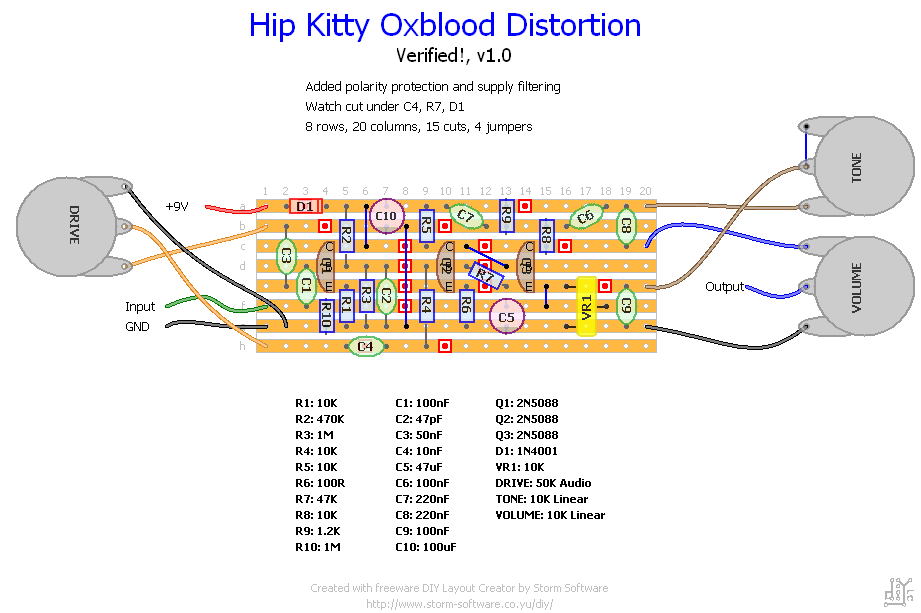
So, it's not a complex circuit - broken down it's a buffered silicon fuzz face with a treble cut control. The first transistor stage is a simple emitter follower, the second and third transistor stages make up the fuzz face with the treble cut control tacked on the end - that's it! The 10k trim pot is used to bias the fuzz face correctly, you can use it to dial in the sort of overdrive you're looking for - anything from around 4v to 7v on the collector of Q3 sounds decent. So why does it make the amp sound small? It's due to those small coupling capacitors - they cut the bass content down and really accentuate the middle and treble frequencies this gives that "boxy" tone. 

So if you want to build one up here's a vero layout for you;


Finally here's the freestompboxes.org forum topic for reference; http://freestompboxes.org/viewtopic.php?f=7&t=4270

Tuesday, 10 July 2012

Blackout Effectors - Mantra Overdrive


More interesting stuff from Blackout Effectors now - the Mantra Overdrive. There's been some hype around this one *and* it comes in a gold enclosure! It doesn't get any better than that :-D

Here's the description of the Mantra Overdrive from the Blackout Effectors website;

"Equally capable of invoking the sacred sounds of a classically refined overdrive AND summoning wickedly raunchy drive, with more crunch on tap than the overdrive moniker usually entails. With such a wide palette of tones and character the MANTRA will feel just as at home at the feet of the stalwart blues crowd as it will the quintessential rock & roll protagonists.

The MANTRA utilizes amp-like circuit architecture, with multiple cascaded MOSFET and JFET gain stages to insure the most natural, touch-sensitive overdrive conditions possible and a seemingly endless range of clean-up with your guitar's volume knob. We burned a lot of midnight oil to make sure that the MANTRA could get down with vintage-type, low output single coils and hot humbucker pickups alike. From gently fingerpicked melodic phrases to bludgeoning riffs that you'll want to play over and over and over..."


With a ProGuitarShop demo video for you;


Sounds pretty sweet and does have a real range of gain available, it's nice and dynamic too - this'll be due to those multiple gain/clipping stages it employs! I always like my "amp like" overdrives (i.e. overdrive circuits that take inspiration from the structure of amplifier pre-amps) to have more tone controls than a simple "treble cut" - I don't think a treble cut gives enough of a convincing EQ curve - the use of the baxandall style tonestack works well though; a plus for the Mantra!

A gutshot of the Blackout Mantra - super clean wiring and construction.
Once again the freestompboxes lot had a peek inside a Mantra overdrive and managed to work something up. The thanks for the majority of work on this one go to KindaFuzzy and RnFR (the tracing was KindaFuzzy and schematic and PCB files are RnFR's);


The circuit structure is slightly more interesting than the standard "Tubes 2 Jfets" topology and shows how mosfets and jfet can be combined to really create an interesting and convincing overdrive clipping structure. The J201 always sounded a little dark to me but with the source resistor set higher as it is in the Mantra (10k) it seems to brighten up a little and not roll off so many highs. It would be interesting to have an option to run either the mosfet section or the jfet section independently for some cool lower gain tones - there's an idea for you modders out there :-)


Here's the freestompboxes.org forum topic for reference; http://freestompboxes.org/viewtopic.php?f=7&t=14562

Blackout Effectors - Twosome Dual Fuzz, Fix'd Fuzz & Musket Fuzz

The Blackout Effectors Twosome playing a bit of Table Football
Blackout Effectors make some really cool looking and sounding boxes. With their introduction into the ProGuitarShop product line I decided to take a look at a few of the nifty fuzz boxes they offer, in particular the Twosome Dual Fuzz and the two circuits which make up the Twosome - the Fix'd Fuzz and the Musket Fuzz.

Before we get started looking at schematics let's check out how the Twosome sounds;


Pretty cool. The sheer number of combinations available with the Fix'd make it one hell of an effect that you could play with for hours and still not find all the tones the Twosome is capable of producing (the red eyes of the owl and rabbit just make it extra special). The one criticism I would have is that you can only run one of the circuits at a time and not run the effects into one another and "stack" them up for even more versatility (although there is a special edition available which does enable you to run both circuits at once).

Here's the description of the Twosome from the Blackout Effectors site;

"The Twosome is a meaty fuzz sandwich made up of the Musket Fuzz pedal and the deluxe version of the Fix'd Fuzz pedal. Both circuits run independently in an A/B configuration allowing you to dial in your perfect fuzz or overdrive tone on each and then switch back and forth between them. You won't find more dirt under one roof - unless you live in a mud hut."

This is a gutshot from an early twosome pedal
So, we're going to need schematic's for both the Fix'd Fuzz and Musket to build one up. Never fear - both schematics are here! First up the Fix'd fuzz, I love the ant graphics;


Here's the description of the Fix'd Fuzz from the Blackout website;

"The FIX'D FUZZ V3 is the hydra-headed dragon of handmade fuzzboxes/boosts/overdrives. Replete with two polar-opposite fuzz tones, a full-bodied boost through light overdrive and a (wide) tone sculpting stage. It delivers BIG diversity in sound - all in a SMALL footprint package designed specifically for the cramped pedalboard. All 4 stages of the circuit are bypassable via their respective toggles, meaning you can add/remove from the stack as your black heart desires."

Fix'd Fuzz schematic (note the 3k9 resistor on the boost transistors emitter is actually 390R)
So, looking the the Fix'd Fuzz schematic there are 4 distinct stages - a standard boost transistor stage - as is seen in the first stage of the Big Muff or in the old Electro Harmonix LPB-1. The second stage "Fuzz 1" is the old DIY classic Hemmo's Bazz Fuss. The third stage "Fuzz 2" is a strangely mis-biased fuzz face circuit. The final stage is a tone control comprised of a Big Muff Pi filter and gain recovery stage.

The regular Fix'd fuzz only has controls for the Boost, Tone and Volume, the rest of the pots are inside as trim pots, the newer Fix'd Fuzz Deluxe has all the controls on the outside of the enclosure.

Fuzz Cat!
And finally the Blackout Musket Fuzz, here's the Blackout description;

"The logical progression from then to now, the MUSKET is based on one of the raunchiest, best selling fuzz circuits of all time - taken three giant muffy steps further. With the addition of the PRE, FOCUS & MIDS controls, the MUSKET is able to traverse the decades, the continents and the many iterations of the classic 4-stage fuzz circuit - from emulation to beyond. If you need fuzz and you need it to be massive...

And bass players, look no further. The Musket brings the thunder to perfectly compliment your lightning. You'll find the Musket on pro bass player boards the world over."


NOTE - You must take into account these corrections to the Musket schematic; 

"R27 470k -> 10k
R17 10k -> 56k
C6, C9 47n -> 100n
C11 100n ->47n"


So yeah, as Blackout says it's a modified Big Muff - an essential weapon in any Guitarists armoury. The "Focus" control is basically a bass blend type control which allows you to dial in the level of bass that hits the front end of the clipping stages - I like this approach, I think removing bass before clipping greatly improves the clarity of the effect.

So if you're into fuzz there are two interesting options for you to look at, although the circuits are pretty standard the manner in which they are combined, especially in the Fix'd Fuzz, makes for some really interesting sounds.