Welcome to the Revolution

Hi there, welcome to my blog - La Revolution Deux. It's an odd name - but I like it! Here you will find all the info on my various DIY Guitar effects builds, amplifiers and guitars. Everything from a humble Ibanez tubescreamer to the holiest KLON Overdrive.

You may also find a few effects builds that I am looking to move on - usually in exchange for other effects/gear/cash. You can always check my ebay account to see what I've got up for grabs.

Have fun, enjoy the blog - Fred Briggs :-)

CONTACT ME


Feel free to get in contact with me about anything you see on this blog or with any general questions about guitars, amplifiers and effects, I'll be happy to answer! Just click the button above to email me directly or alternately my email address is fredbriggs2007 [at] googlemail [dot] com

Search This Blog

Showing posts with label Fuzz. Show all posts

Tuesday, 10 July 2012

Blackout Effectors - Twosome Dual Fuzz, Fix'd Fuzz & Musket Fuzz

The Blackout Effectors Twosome playing a bit of Table Football
Blackout Effectors make some really cool looking and sounding boxes. With their introduction into the ProGuitarShop product line I decided to take a look at a few of the nifty fuzz boxes they offer, in particular the Twosome Dual Fuzz and the two circuits which make up the Twosome - the Fix'd Fuzz and the Musket Fuzz.

Before we get started looking at schematics let's check out how the Twosome sounds;


Pretty cool. The sheer number of combinations available with the Fix'd make it one hell of an effect that you could play with for hours and still not find all the tones the Twosome is capable of producing (the red eyes of the owl and rabbit just make it extra special). The one criticism I would have is that you can only run one of the circuits at a time and not run the effects into one another and "stack" them up for even more versatility (although there is a special edition available which does enable you to run both circuits at once).

Here's the description of the Twosome from the Blackout Effectors site;

"The Twosome is a meaty fuzz sandwich made up of the Musket Fuzz pedal and the deluxe version of the Fix'd Fuzz pedal. Both circuits run independently in an A/B configuration allowing you to dial in your perfect fuzz or overdrive tone on each and then switch back and forth between them. You won't find more dirt under one roof - unless you live in a mud hut."

This is a gutshot from an early twosome pedal
So, we're going to need schematic's for both the Fix'd Fuzz and Musket to build one up. Never fear - both schematics are here! First up the Fix'd fuzz, I love the ant graphics;


Here's the description of the Fix'd Fuzz from the Blackout website;

"The FIX'D FUZZ V3 is the hydra-headed dragon of handmade fuzzboxes/boosts/overdrives. Replete with two polar-opposite fuzz tones, a full-bodied boost through light overdrive and a (wide) tone sculpting stage. It delivers BIG diversity in sound - all in a SMALL footprint package designed specifically for the cramped pedalboard. All 4 stages of the circuit are bypassable via their respective toggles, meaning you can add/remove from the stack as your black heart desires."

Fix'd Fuzz schematic (note the 3k9 resistor on the boost transistors emitter is actually 390R)
So, looking the the Fix'd Fuzz schematic there are 4 distinct stages - a standard boost transistor stage - as is seen in the first stage of the Big Muff or in the old Electro Harmonix LPB-1. The second stage "Fuzz 1" is the old DIY classic Hemmo's Bazz Fuss. The third stage "Fuzz 2" is a strangely mis-biased fuzz face circuit. The final stage is a tone control comprised of a Big Muff Pi filter and gain recovery stage.

The regular Fix'd fuzz only has controls for the Boost, Tone and Volume, the rest of the pots are inside as trim pots, the newer Fix'd Fuzz Deluxe has all the controls on the outside of the enclosure.

Fuzz Cat!
And finally the Blackout Musket Fuzz, here's the Blackout description;

"The logical progression from then to now, the MUSKET is based on one of the raunchiest, best selling fuzz circuits of all time - taken three giant muffy steps further. With the addition of the PRE, FOCUS & MIDS controls, the MUSKET is able to traverse the decades, the continents and the many iterations of the classic 4-stage fuzz circuit - from emulation to beyond. If you need fuzz and you need it to be massive...

And bass players, look no further. The Musket brings the thunder to perfectly compliment your lightning. You'll find the Musket on pro bass player boards the world over."


NOTE - You must take into account these corrections to the Musket schematic; 

"R27 470k -> 10k
R17 10k -> 56k
C6, C9 47n -> 100n
C11 100n ->47n"


So yeah, as Blackout says it's a modified Big Muff - an essential weapon in any Guitarists armoury. The "Focus" control is basically a bass blend type control which allows you to dial in the level of bass that hits the front end of the clipping stages - I like this approach, I think removing bass before clipping greatly improves the clarity of the effect.

So if you're into fuzz there are two interesting options for you to look at, although the circuits are pretty standard the manner in which they are combined, especially in the Fix'd Fuzz, makes for some really interesting sounds.

Thursday, 5 July 2012

Tycobrahe - Octavia

An original Tycobrahe Octavia Pedal
There aren't many Tycobrahe pedals around, the company was only in the pedal business for a few years before it ceased manufacturing. One of it's most infamous (and yes, I do mean infamous - have you heard this thing?!) offerings is the Tycobrahe Octavia fuzz pedal. As rumour has it the Tycobrahe Octavia came into being after one of Roger Mayer's (who was Jimi Hendrix's FX guy) original Octavia circuits was taken into Tycobrahe for repair and was traced out by an employee.


Above you can see (supposedly) the schematic that was traced by a Tycobrahe worker from the hand made Roger Mayer pedal. Here's a bit more info from the Radio WC6W website; 


"This is the schematic, traced from the pedal that was brought, by a "Jeff Beck" crew member, to Tycobrahe Sound for repair, which became the genesis of the Tycobrahe Guitar Pedal line. The polarity "fixes" that resulted when the demarked transistors were removed and analyzed on a Tektronix curve tracer may be seen on this first draft."


For those of you who sport a pair of glasses or are drunk, here's an easier to read schematic;


Looking at the schematic the Octavia is pretty simple - a high gain fuzz circuit driving the octave generation circuit comprising of a small audio transformer and a couple of germanium diodes. If you want to cancel the octave up effect all you need to do is switch one of these diodes out of the circuit.

The Octavia is an evil sounding beast with a huge amount of fuzz available, twin that with the octave up (it makes all notes played sound an octave up) effect and the swells and bloom that you get and you've got one of the Devil's favourite FX pedals. Check out this demo of the Octavia in action to see what I mean;


It's a very specific sound, you can hear the Octavia employed well on "Purple Haze" by Jimi Hendrix and many of his tracks with the Band of Gypsies.

Gutshot of an original Tycobrahe Octavia
So what if you fancy building one and cracking out some of the old Hendrix licks? Well, here's a vero layout for the Tycobrahe Octavia by Dr Tony Balls. This is an NPN negative ground layout (unlike the original which was PNP positive ground) which means you can use it with your pedal power daisy chains without a problem;

Wednesday, 20 June 2012

Fred Briggs - Pharmacy Fuzz


Here's something I've never seen before in a Fuzz Face type circuit; adjustable gain darlington pair transistors made up of individual germanium and silicon transistors. The first transistor of each pair is a germanium device of around 50hfe (low leakage!) and the second is a silicon device of around 250hfe. The adjustable nature of the transistors makes the Pharmacy Fuzz capable of a huge array of both vintage and modern fuzz tones - you can tweak and play with the circuit for hours and still find new possibilities.

When I build this up I'll be using a 100k trim for the gain control on the first transistor set and a 100k pot for the control on the second transistor set as this secondary pair is where most of the clipping magic happens (or indeed just use a single low/medium gain transistor instead of the first pair for simplicity). Also note the "Aggression" and "Bass Cut" controls. The "Aggression" control works as a circuit wide "overall gain" control and allows the circuit to go from mellow to full on rock out. The "Bass Cut" is just an implementation of the now pretty standard Fuzz Face tone blend control and governs the amount of low end signal that the circuit will gobble up at it's front and and fuzz out at it's end.

The 10k trim is there for bias - use this to set the voltage on the collector of the second transistor set to around half the supply voltage, or to wherever you think it sounds best!

You'll also note a few other little inclusions in the design - the 2 x Ferrite Bead inductors in series with the input of the circuit and the Suppression Choke in the power supply (whose overall resistance should be in the 50-100 ohm) region. These components together help to reduce noise and radio interference in the circuit. If you don't have them replace the suppression choke with a 100 ohm resistor and just omit the ferrite beads.

Thursday, 14 June 2012

Lovepedal - Silicon Fuzzmaster


Here's another Lovepedal for you. What's in this one I wonder? Well, IVIark (of the great tagboardeffects.blogspot.com) has provided a trace and schematic with the help of rmrosa. Firstly lets see the Lovepedal description;

"Your quest for the ultimate Fuzz ends here.

Lots of players use it like an OD pedal or full on fuzz, even distortion.. Roll back the guitar's volume and you're left with a lively shimmer atop your guitar and amp's identity. Amazingly, this happens to an appropriate degree throughout the pedal's range, and without the annoyingly excessive boost in volume that many overdrive pedals generate. And, yes, it's dead quiet.

The Fuzzmaster is a VERY sweet, smooth, silicon transistor based, fuzz that is warm, organic and sings with sustain. While it has an UN-mistakable vintage tendency, it also has a unique voice. Vintage Fuzz Face tonal heaven and everything in between, even tweed amp tones are in there."

And we're going to need a nice ProGuitarShop demo too;


So it sounds good enough, now lets have a look at it's innards - here's the schematic;


So it's the standard Fuzz Face circuit with a few tweaks - firstly the Blend cap which controls the bass level (and overall fatness) and slightly altered gain control network. The main change is the way the circuit utilizes PNP transistors but is still wired as a standard negative ground circuit (so it doesn't require it's own isolated power supply!). It's a clever trick that has been around for a while now.

Note, rmrosa (who provided the circuit to trace from) noted down these voltages from the original:

"The stock setting of the 10k trimmer on the PCB layout is 2.73k
Q1:
1 - 1.46V
2 - 6.62v
3 - 7.24V

Q2:
1 - 6.62V
2 - 7.48V
3 - 7.93V"


And, finally, here's the freestompboxes.org forum topic for any more info you require; http://freestompboxes.org/viewtopic.php?f=7&t=17975

Sunday, 1 April 2012

You Tube Tutorials - Tone Bender MKI & Echoplex

Here's some interesting youtube videos for you. First up - a couple of videos on how to build your own Tone Bender MKI replica:


Echoplex restoration:


Friday, 30 March 2012

Nine Volt Nirvana - Fuzz Pedals and Boosters


Nine Volt Nirvana Fuzz pedals have been around since the late 1990s, some of Joe Gagan's designs were what got me interested in stompboxes back in the early 2000s. Now Nine Volt Nirvana is no longer around, luckily Joe drew out circuit schematics around for his pedals so that clever DIYers like yourselves could make your own.

Here's the schematics for his coolest stuff:

Firstly the "Bronto Booster" - this one is a favourite of many gain freaks and does everything from straight boost through to great fuzz tones. Here's a demo of the Bronto Boost in action:


The "Easy Face" was a really popular build in the early days of the DIY scene and was capable of creating some really cool Fuzz Face tones. The combination of a silicon transistor for Q1 and a germanium transistor in Q2 set the foundation for many boutique Fuzz pedals for the years that followed.

Here's a demo of the GT Fuzz  and Dino Drive in action:


The "Sky Ripper" Fuzz was one of the first pedals I ever built and I've still got it around (Somewhere!). I built this one as I couldn't find a schematic for the then uber-secret Zvex Fuzz Factory. It's so tweakable it's mindbending when you get into it. I think I spent three weeks playing this pedal solidly and I still didn't find all the tones that it was capable of. When I built the Zvex Fuzz Factory a few years later it was a close match between these two as to which I liked best. I never really decided and I have both in my Fuzz collection. The Sky Ripper could almost count as a synth on it's own!


So there they are, some of Nine Volt Nirvana's best pedals. If you've got a stash of germanium transistors get building some of them (especially the Bronto Boost, the Easy Face and the Sky Ripper) - you won't be disappointed :-)

Wednesday, 28 March 2012

Fred Briggs - Unknown Fuzz


A new fuzz design from myself. It's silicon transistor based but with a difference. I've been playing around with the old Vox Tonebender circuit for a while and this is what sprung from those experimentsTaking inspiration from the Fred Briggs Fuzz I made a few years ago that used "piggy-backed" silicon transistors to emulate lower gain germanium devices I used a couple of piggy backed high gain silicon trannys in the first stage with the hfe set to 25. This first stage pushes a NOS BC108 transistor in the second stage - it sounds great, there's no ear shredding like the usual silicon fuzz boxes just a nice fat low end and a warm mid section. The three controls are for 1; a bass cut, 2; a width control (which adjusts how "wide" and gainy the fuzz sounds) and the third is just a volume control. As you can see there is no "usual" gain control, that's because the only gain control you need is your guitar's volume knob, it'll do everything from mild overdrive right through to full on FuZzZzZzZz.

So, here's the schematic for you:


*NOTE* - To further control the high end and upper mids I would recommend you add in a 2n2 cap in parallel with the 22K resistor and 100kB "Width" pot. It really calms down the harsh frequencies. I included the 2n2 cap on my final build!

*NOTE 2* - Piggy backed transistors are a little picky, you may have to pair up a few 2N5088 transistors before you find a couple that are happy together :-)

I'll be updating this with a sound sample as soon as possible!


Tuesday, 27 March 2012

Tim Escobedo - Tytewadd Fuzz


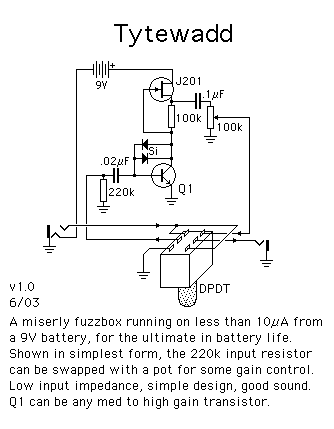
Here's another one of Tim Escobedo's great "circuit snippets" - the Tytewadd Fuzz. As you can see it's reminiscent of his Syrupp Booster:
Using that top jfet as a simple current regulator bangs up the gain in the circuit and allows this single transistor gain stage to create some epically big fuzz tones. I had a play with this the other day and really enjoyed it's tone and simplicity - I would certainly recommend this build for anyone who enjoys Big Muff-ish tones.

Thursday, 22 March 2012

Sola Sound / Vox - Tone Bender 3 Knob (MKIII) / Fulltone - Soul Bender

[NOTE - This post also contains details of the Fulltone Soul Bender]

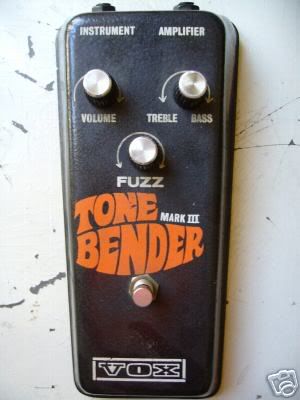
Vox Tone Bender Mark III
Introduced in 1968 the Sola Sound Tone Bender MKIII is the last in the line up of the classic Tone Bender circuits. It produces a more mellow, less aggressive fuzz than the MKI & MKII Tone Bender circuits. Once again it uses a 3 transistor design but the structure is significantly different to previous incarnations of the Tone Bender. As you can see below the Tone Bender MKIII came in various guises:

Sola Sound Tone Bender MKIII
Colorsound Tone Bender MKIII
Another Sola Sound unit
Sola Sound Tone Bender MKIII Gutshot
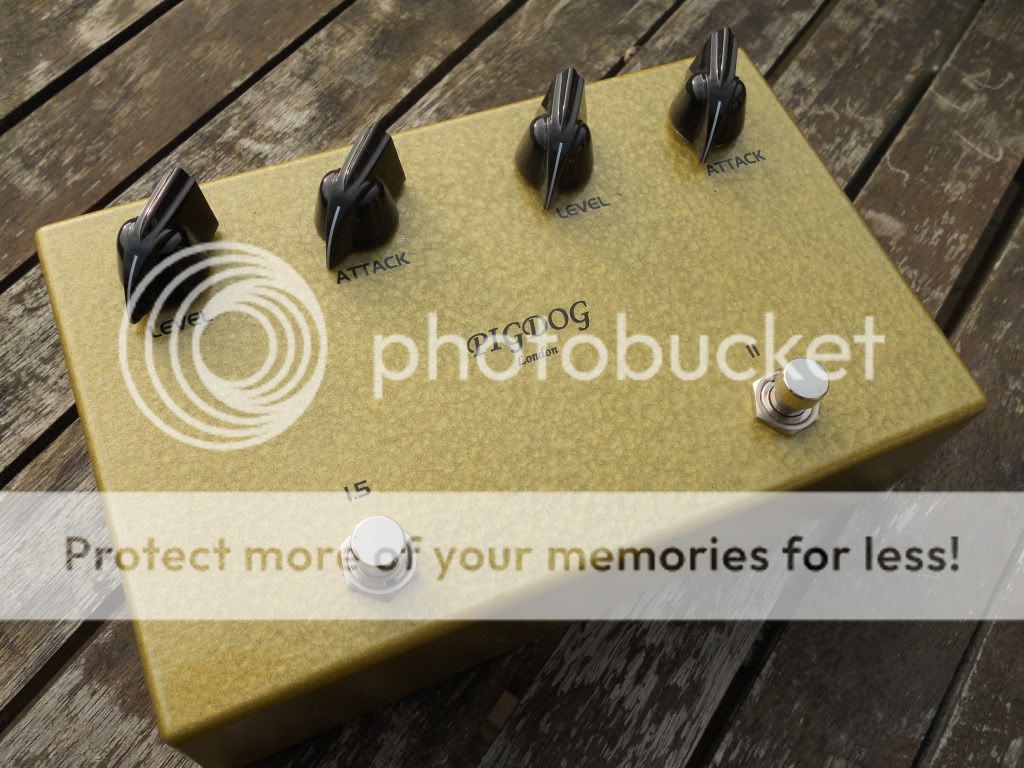
Now although the fuzz produced by the MKIII isn't as agressive as previous Tone Benders it can still produce an unholy amount of Fuzz. Here's a demo video of the MKIII Tone Bender circuit in action (Note - it's a Pigdog MKIII):


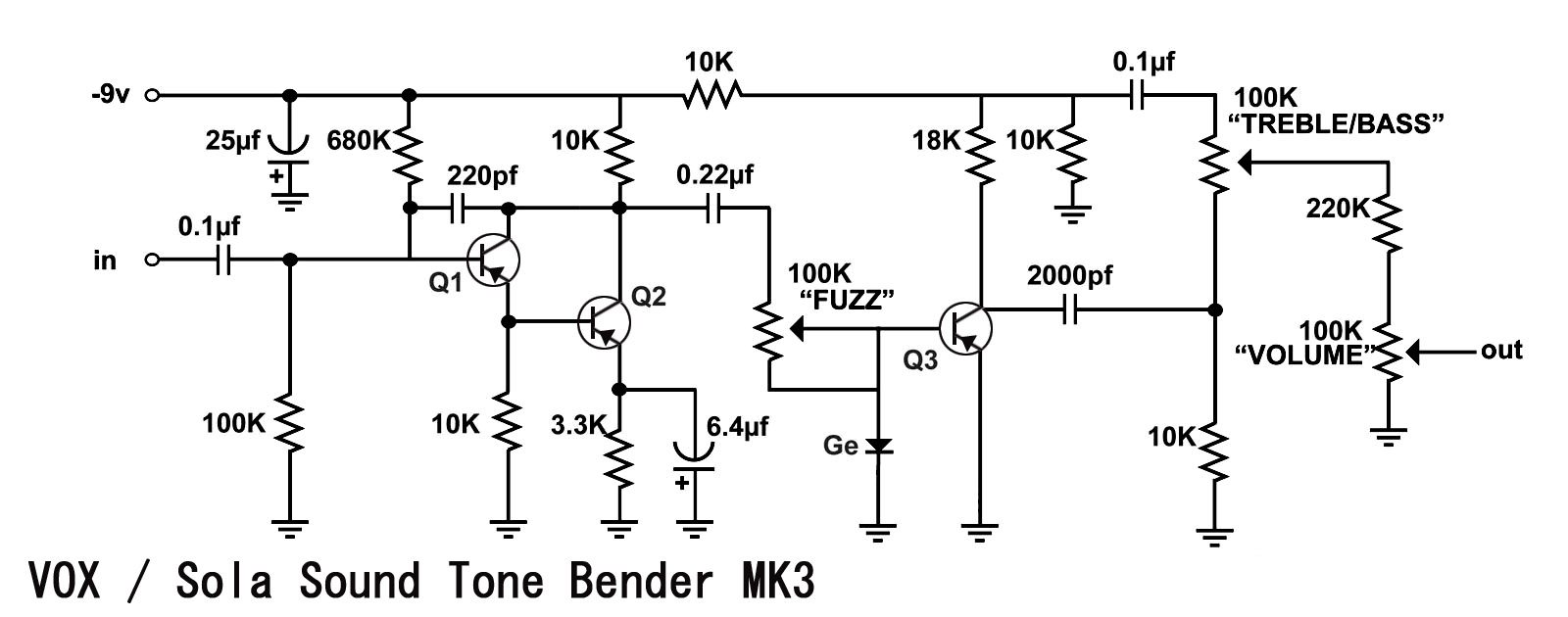
Here's the schematic for the most widely distributed version of the Sola Sound Tone Bender MKIII:


In the original the transistors were unmarked PNP Germanium and the diode was a 1N270. I'd recommend using a pair of lower gain (40-60 hfe) for Q1 and Q2 and a higher gain 90-120hfe for Q3. If you want to see the variations on the Tone Bender MKIII design then check out: http://fuzzcentral.ssguitar.com/3knob.php, there are details on the Park Fuzz Sound and Prescription Electronics Yard Box there.

Here's a vero layout created by Electric Warrior (Note - he used a 250K Volume pot):


And here's some images of his completed build:


And here's some info regarding the Fulltone Soul Bender:

And a description:

"Our Soul-Bender is based on the legendary Colorsound and Vox Series III ToneBenders made by Sola-Sound/England in the late '60's that was used by Beck and Page on much of their circa 1968-70 recordings.

Equipped with 3 gain-matched germanium transistor for a FAT, searing lead tone, I also made the Tone control response and range more usable and much less shrill sounding... Full clockwise is SMOOTH sounding.

The Soul-Bender cleans up when you back-off on the guitar's volume control. This pedal has tons of tonal character and even harmonics and of course, true bypass w/ LED is included with every one."
And a vero layout for the "Boutique Bender":


For more info on the Sola Sound Tone Bender MKIII check out Effects Database here: http://www.effectsdatabase.com/model/solasound/tonebender/mk3

And here's the Freestompboxes.org forum topic: http://www.freestompboxes.org/viewtopic.php?f=19&t=7728

Wednesday, 21 March 2012

Builder Overview - Pigdog Effects

Pigdog Fuzz 1.5 - Tone Bender MK1.5 Replica
Pigdog Fuzz 1.5 Gutshot
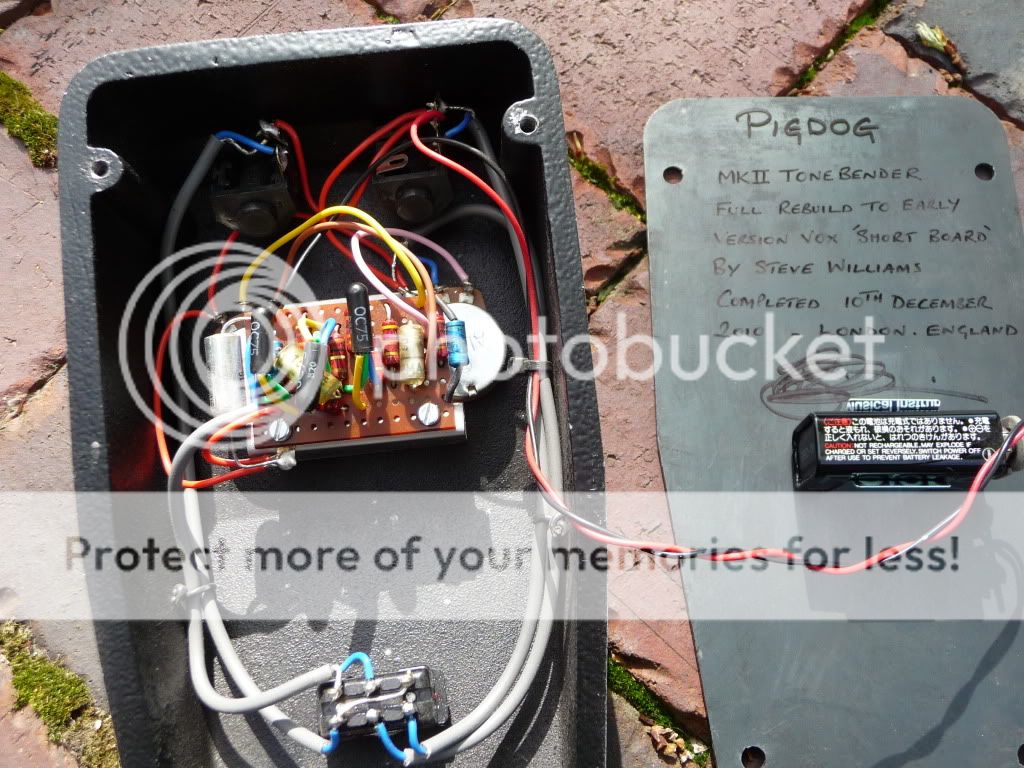
Pigdog Effects are the creations of Steve Williams and they're grown in his organic pedal allotment which is located in London, England. As you can see from the images above and below his creations are some of the finest available - the build quality and aesthetic is second to none; just check out those gutshots. Here's a small interview with Steve that was conducted by Bart over at the great www.Effectsdatabase.comhttp://www.effectsdatabase.com/interviews/brands/pigdog

Black Case Pigdog Fuzz 1.5
Gutshot of Black Case Pigdog Fuzz 1.5
Pigdog Fuzz 1.5 & II Combo (Tonebender MK1.5 & MKII Pro)
Gutshot of Pigdog combo
Pigdog Mini Competition Driver (Rangemaster + input cap blend)
Gutshot of Pigdog Mini Comp Driver
Pigdog Tonebender MKII Professional Rebuild
Gutshot of Tonebender MKII Rebuild
Pigdog Fuzz (MKIII Tone Bender Replica)
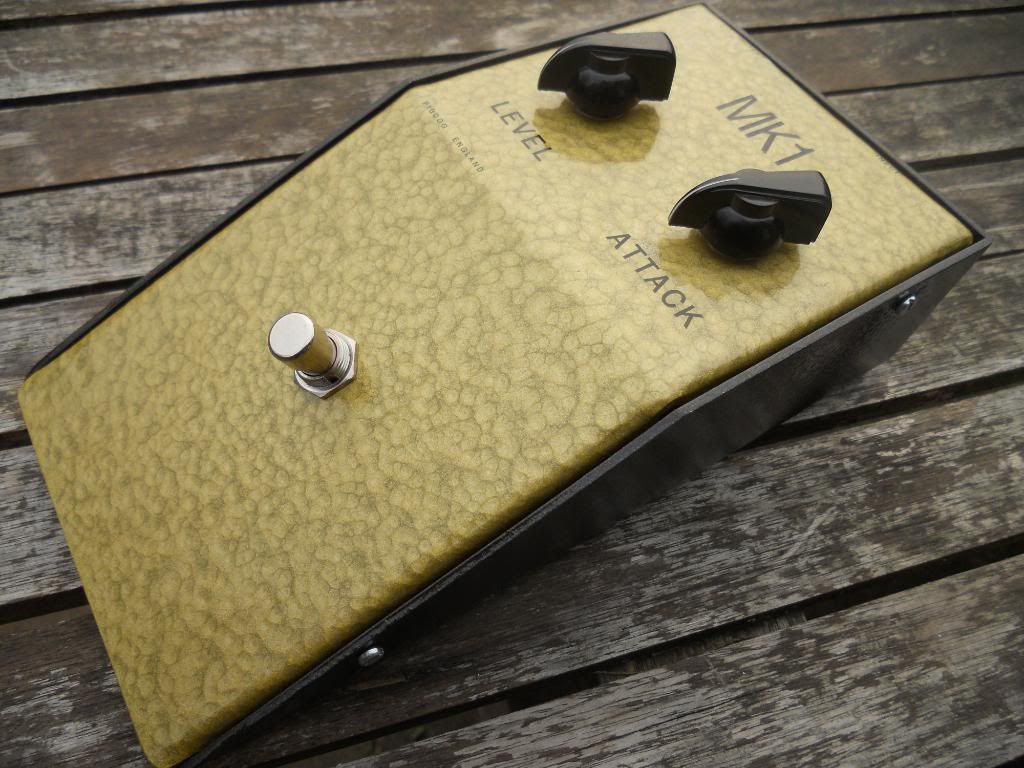
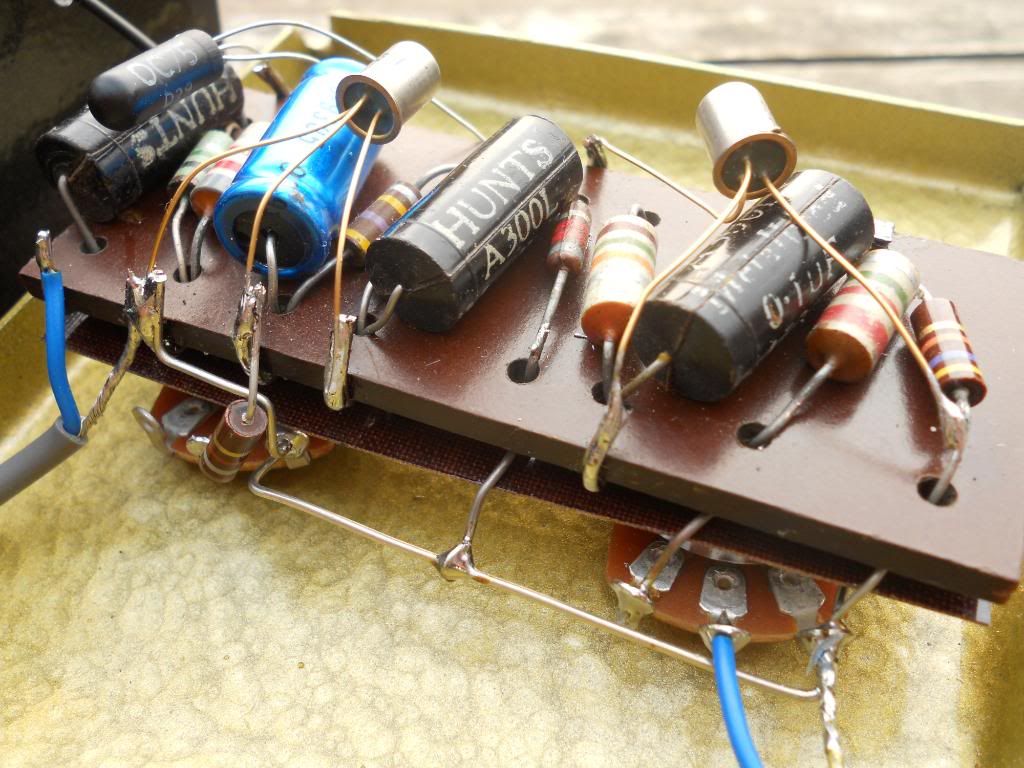
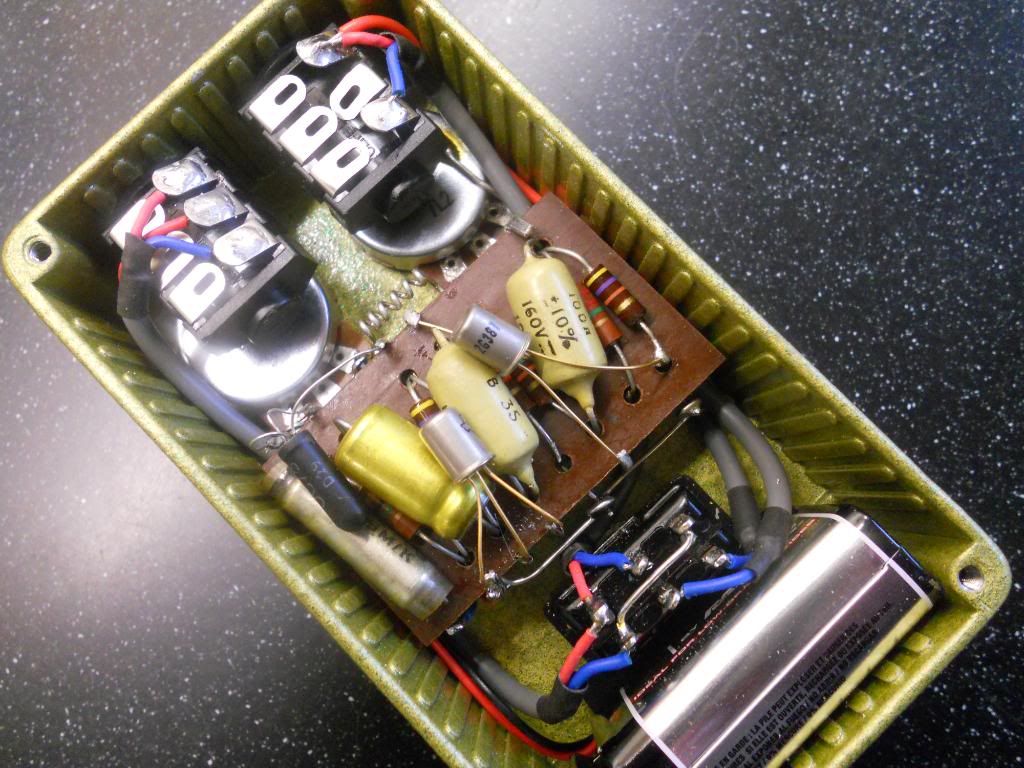
Check out the construction method here on the Pigdog Tone Bender MKI replica below and compare it to the original Tone Bender MKI - The case is a replica of the original MKI folded steel case the circuit is constructed point to point on a through hole board - replicating the exact manner in which the original MKI Tone Benders were made. Even the same brand of capacitors have been sourced as NOS:

Pigdog Tone Bender MKI

Original Sola Sound LTD Tone Bender MKI
Gutshot of Pigdog Tone Bender MKI
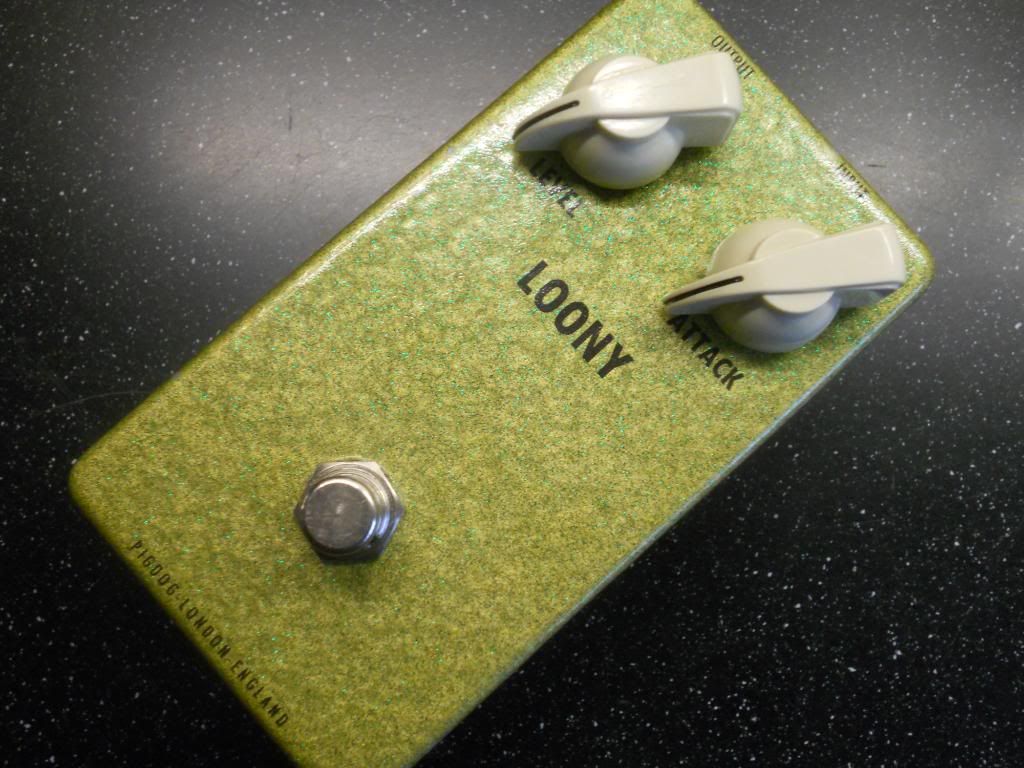
And this Loony has had a coat of green speckled Nitro applied, check out the effect it has on the Hammerite case:

Pigdog Loony (Tone Bender MKI Replica)
Pigdog Loony Gutshot
Pigdog Electric Eye Fuzz
Pigdog Electric Eye Gutshot
And now a few demo videos of Pigdog pedals in action - it's the Loony first then the Electric Eye and finally the Pigdog Mother:


So there you go - top quality building and great tones too what more do you want? If you want to know more about Pigdog check out: http://www.pigdogpedals.co.uk/ (Note- the website is still under construction but there is an email address there). Or alternatively if you visit the D*A*M Forum his username is "dazed and confused".