Welcome to the Revolution

Hi there, welcome to my blog - La Revolution Deux. It's an odd name - but I like it! Here you will find all the info on my various DIY Guitar effects builds, amplifiers and guitars. Everything from a humble Ibanez tubescreamer to the holiest KLON Overdrive.

You may also find a few effects builds that I am looking to move on - usually in exchange for other effects/gear/cash. You can always check my ebay account to see what I've got up for grabs.

Have fun, enjoy the blog - Fred Briggs :-)

CONTACT ME


Feel free to get in contact with me about anything you see on this blog or with any general questions about guitars, amplifiers and effects, I'll be happy to answer! Just click the button above to email me directly or alternately my email address is fredbriggs2007 [at] googlemail [dot] com

Search This Blog

Monday, 23 January 2012

OKKO - Dominator

The OKKO Dominator is a super high gain distortion machine from Germany. I love those massive LEDs they have as a status indicator. They also sound pretty damn mean too! This thing is in the same ball park as the Wampler Triple Wreck - that gives you some idea of the amount of gain this thing has!

Here's a description from the OKKO website:

"After countless hours of tweaking and improving the circuit, I’m proud to present you the DOMINATOR high gain drive.Aggressive british crunch, classic heavy metal, brutal modern high gain stuff or anything in between – the Dominator will do the job.
This box has nothing in common with those overcompressed, artificial sounding "bedroom metal" distortion pedals that disappear in the mix if you try to use them in a real band situation. Raw natural gain structure, explosive attack, tight low end and great chord definition make the difference – the Dominator works equally well at home practice or stage level.

The active 3-band EQ with switchable mid range frequency provides effective and intuitive control over a broad range of sounds.

Just like the other OKKO drive pedals, the Dominator features an internal voltage doubler. The three gain stages and the EQ stage operate on different individually filtered voltages up to 18 volts for optimal dynamic response and very low noise performance.

The Dominator works best in front of a clean amp with some headroom, especially if you use very bass heavy "chugga chugga" settings."

And a demo video of the OKKO Dominator in action:


Here's an internal gut shot:


Here's the schematic drawn up by Saruman:


As you can see it's an opamp clipper running at a higher voltage than usual with the distortion coming from the clipping in those opamps! I'm not usually keen on opamp clipping but it does sound pretty good in the Dominator.

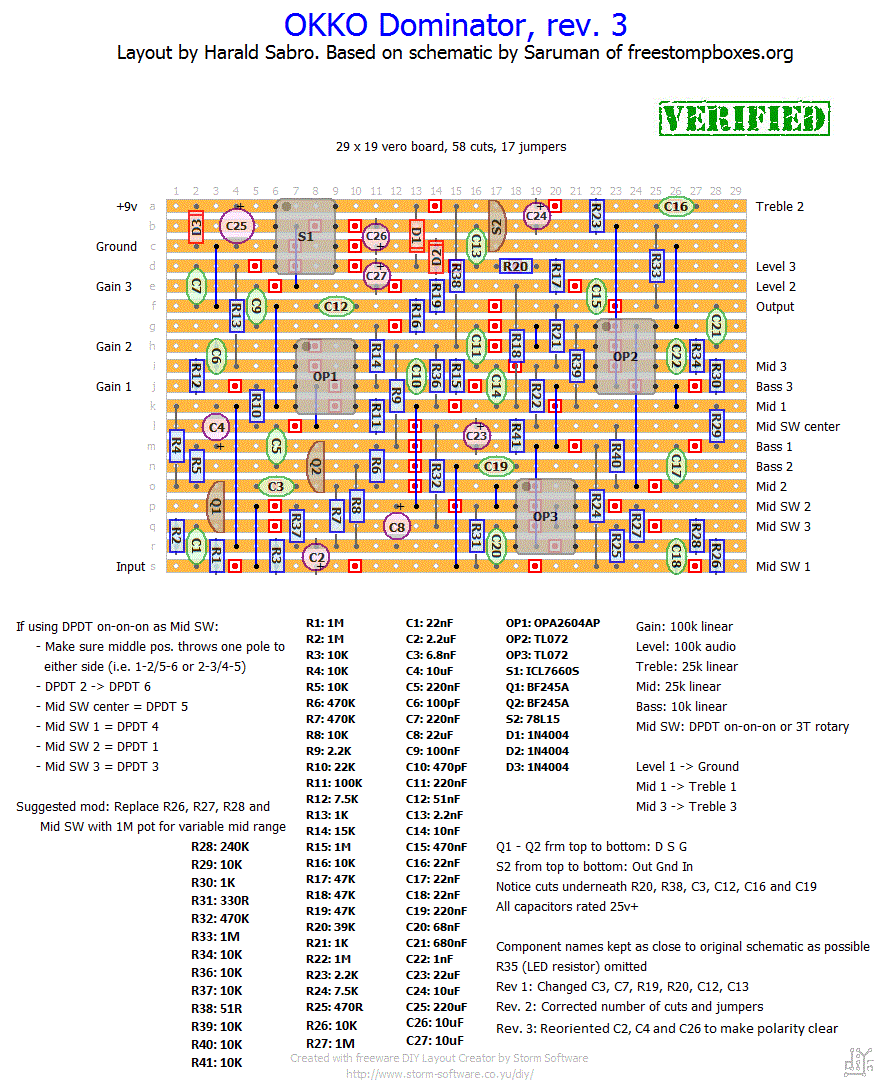
Anyway, heres's a vero layout by Harald Sabro (http://www.sabrotone.com):


And a PCB layout and associated files by Mundry: http://www.box.com/s/n7iekvtxtgjx6z1rbq3v

And the freestompboxes.org forum thread for reference: http://freestompboxes.org/viewtopic.php?f=7&t=12031

Carl Martin - Plexitone


The Carl Martin Plexitone has been around for yonks (good word!) and has remained popular with it's high gain tones and wide versatility allowing the Plexitone to cover most bases required when playing anything other than Folk (Yuk) music.

Here's the description from the Carl Martin website:

"The Carl Martin PlexiTone, is as the name might indicate an unusual high gain three step rocket of an overdrive.The PlexiTone offers two step overdrive, the crunch channel and the high gain channel, on top of that it gives you an up to 20dB clean boost channel.
The crunch channel goes from subtle overdrive to hard rock gain stage, the high gain channel goes from rock gain stages to absolutely meltdown, with loads of gain and low end, and all in a tone that brings the memory back to the early 80's high gain guitar hero's.
The PlexiTone has as most Carl Martin pedals a built in regulated (+/-12V) power supply, to secure the necessary headroom that gives you the great tone."
Check out this comprehensive demo video of the Plexitone in action:


As you can see it sounds pretty nice. I bet you wanna know what's going on in there. Well here's the schematic provided by GnognoFasciani:


As you can see we've got the standard opamp type clipping circuit with a couple of LEDs in there to provide the distortion BUT with an interesting change - that dual +12v to -12v supply provided by the onboard transformer. This gives the pedal it's great headroom and dynamic appeal by ensuring that the opamp is never pushed into it's clipping region, this means all the clipping is done via the LEDs and not harshly in the opamp itself.

Here's a PCB layout by Bucksears:

As you can see he's used a voltage doubling circuit to supply the opamp with +/-18v - even more headroom! I like this, I like it a lot! Here's the link to the PCB transfer he produced: http://www.box.com/s/qe94dk4inkufhtk2nlid

And here's a link to the freestompboxes.org forum topic for reference: http://freestompboxes.org/viewtopic.php?f=7&t=1113

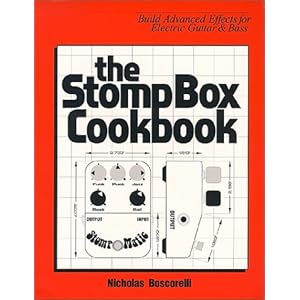
Nicholas Boscorelli - The Stompbox Cookbook


http://dl.dropbox.com/u/1822991/The%2BCookbook.pdf

There are a couple of links to sites where you can download the pdf of Nicholas Boscorelli's "The Stompbox Cookbook". Just a year or so ago this book was selling for hundreds second hand and it's out of print so no one could access all the info inside without shelling out the $$$. Now thanks to a few generous people it's free for everyone to see. There are some interesting projects in there, nothing too revolutionary but it certainly worth a read. The section on envelope detection and control is quite interesting and it's got really in depth descriptions of most aspects of common stompbox circuits - perfect for a beginner or someone more advanced.

Sunday, 22 January 2012

Brunetti - Mercury


Brunetti are an Italian company who make some really great sounding amps and stompboxes. The Mercury Box is there overdrive pedal. Here's the description from the Brunetti website:

"Mercury Box is the new Brunetti overdrive/ distortion stomp box. A small metallic box holds together the qualities of the well-known CustomWork Mercury’s channel 2! It is endowed with “FET” technology to reproduce tubes behavior and dynamics as accurately as possible. Mercury Box is extremely versatile, you can move from clear and defined crunch sounds to hard rock “liquid” distortion which is always clean and never shapeless, very smooth and respectful of your instrument timbre, even at high gain levels. Controls are soft and sentive, but effective at the same time. They indeed interact thoroughly as in a real tube amplifier. Mercury Box arises from careful design and long lasting research of Marco Brunetti, and the outcome is innovative and technologically unique. It is not the upgraded clone of a well-know stomp box! These qualities make Mercury Box different, we are sure you will be impressed at first note!"

And a demo video of the Mercury in action (This is a clone built from the verified schematic below):


The chips are a MAX1044 or ICL7660 charge pump and a TL071 single opamp.

As the schematic shows the Mercury Box has a single op amp gain stage running into two jfet gain stages. Jfets do sound great as a clipping device. The whole circuit is powered at 18v via the charge pump, that adds headroom and dynamic range. All in all it's a pretty well designed circuit and it sounds neat too! One change I would make would be to replace the 22k drain resistors on the Jfet stages with 2 47k trim pots which would allow you to really dial in the sweet spots for maximum gain and sustain.

Here's the freestompboxes.org topic for reference: http://freestompboxes.org/viewtopic.php?f=7&t=9846

Penny Pedals - Fingerprint


The Penny Pedals Fingerprint has been out for a couple of years and is a decent sounding overdrive pedal that can do full on octave glitch fuzz when the texture and gain knobs are set in the right positions. Here's the *long* description from the Penny Pedals website:

"My newest pedal is a collaboration between myself and artist Laura Bennett. Known for painting unique designs on a few other company's pedals, this is the first time anyone has actually let her create her own pedal from the ground up, including the sound of the circuit and a blank canvas on the box.

Using inspiration from certain bands, sounds, even just random words, the sound of the pedal pays homage to that "wall of sound" heavy distortion. The pedal has lots of available gain and volume, similar to the clear but still insanely heavy sounds of bands like My Bloody Valentine, Smashing Pumpkins, Jesus and Mary Chain, etc... It's a high gain pedal for those who don't want to sound like a cliche heavy metal sound, a nice blend between high gain amp-like distortion, fuzz, gated fuzz, octave fuzz, and everything in between.

The controls are volume, gain, and texture. volume and gain are pretty easy to understand and work in the traditional ways, but texture is a unique feature. The only way I could create the tone we were after for this was to make the circuit as amp-like as possible, and that's where the texture control comes in; it is sort of similar to the negative feedback found on some amps, except controllable. At it's lowest settings, it lets the rest of the circuit take over for nice "normal" distortion pedal sounds, from clean-ish "just there" grit to high gain crunchy tones. As you turn the texture up, things get more fuzzy, and seem to have even more gain with more of a fuzz than distortion flavor... then, about half way, a slight gate kicks in, allowing you to have an eerie brief silence between notes (this depending on the gain knob also)... and with the gain full up, and the texture maxed, odd, crazy octaves and random notes happen, almost uncontrollable... low notes instantly trigger a lower octave then jump up to the root, creating broken robot type sounds reminiscent of a traditional octave fuzz... high notes fizzle and chords make sounds that are just... well... weird.

Truly a fun, unique collaboration and an awesome looking and sounding pedal."

Here's a demo video of the Penny Pedals Fingerprint in action:


Here's the schematic drawn up by CultureJam:


Here is a vero layout:


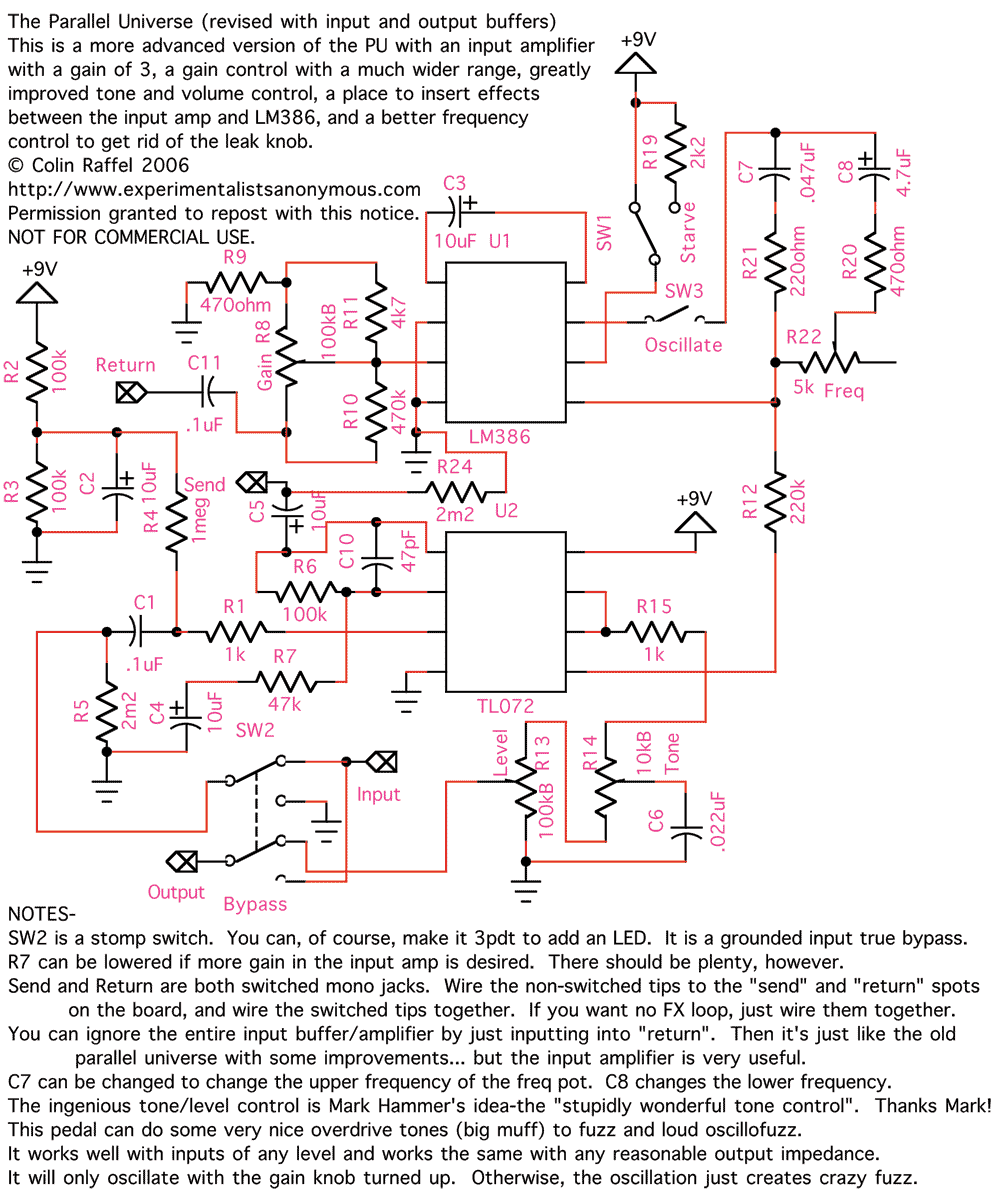
Note that the newer Fingerprint pedals have a bypass switch to switch the gain pot to full on. Aparently the NJM386 is pretty important to the overall sound of the pedal. It's just another 386 design (there are a few about now!), but they do produce a fairly decent tone. The only real interesting part here is the texture control which is just operating as a feedback loop to force the circuit into oscillation. The Experimentalists Anonymous Parallel Universe utilizes a 386 chip but it forces it into oscillation in a slightly different manner and it's got a wider range of tones than the Fingerprint (Although it is more complicated to build!). If you're into making a racket build one of these - here's the schematics for the old and new versions (both are decent enough):


And, as usual, the freestompboxes.org forum topic for reference: http://freestompboxes.org/viewtopic.php?f=7&t=2503