Hi there, welcome to my blog - La Revolution Deux. It's an odd name - but I like it! Here you will find all the info on my various DIY Guitar effects builds, amplifiers and guitars. Everything from a humble Ibanez tubescreamer to the holiest KLON Overdrive.
You may also find a few effects builds that I am looking to move on - usually in exchange for other effects/gear/cash. You can always check my ebay account to see what I've got up for grabs.
Have fun, enjoy the blog - Fred Briggs :-)
CONTACT ME
Feel free to get in contact with me about anything you see on this blog or with any general questions about guitars, amplifiers and effects, I'll be happy to answer! Just click the button above to email me directly or alternately my email address is fredbriggs2007 [at] googlemail [dot] com
Ala Freakish Blues the people behind "Toxic Pedals" have gone and done the "buy cheap JOYO clones, repainted/rebrand them and then sell them on as your own." trick. It turns out the Toxic Pedals "Muddy Drive" is the Joyo "Ultimate Drive" (Which is itself a clone of the Fulltone OCD/Voodoo Labs Overdrive) which has been repainted and had a few values on the circuit board switched. Here's some images of the Toxic Pedals "Copenhagen Muddy Drive":
Here's an image of the Muddy Drive (on the left) compared to the Joyo "Ultimate Drive" (on the right):
And if that's not enough here's an image of the top side of the Muddy Drive PCB:
Now, there's nothing technically/legally wrong with doing this. I just think it's a bit cheeky, wouldn't you agree?
People like the Klon, they like anything to do with the Klon. People have been building up the Buffer section of the Klon and selling them as a standalone unit. Well, there's the schematic of the buffer section and here's a vero layout from Mcaviel:
Now many people ask me why use a buffer? What does it do? The short answer is that if you use 1) Long cables or 2) Lots and lots of true bypass fx or 3) Low input impedance FX (Fuzzes, Wahs) then you are probably experience "Tone suck" - a loss of high end "sparkle" with your tone. A Buffer can be used to counteract this when used in the correct position. For an excellent article covering buffers and their use check out this: http://screaminfx.com/tech/why-and-when-to-use-a-guitar-buffer-pedal.htm
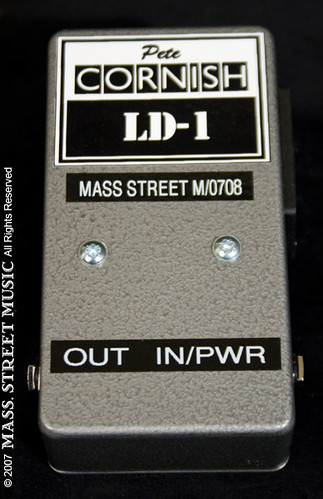
So inside all of his pedals he includes a buffer to aid the switching process and act as a line driver for the remainder of the pedal chain. He sells these individually as the LD-1 (and LD-3 with the mute switch and tuner output).
"Our low noise discrete component Class A pre-amplifier has been specifically designed to overcome the problems often encountered with amplification of Electric Instruments fitted with magnetic transducers.
A frequent cause of these problems is the mismatch of the impedance in the electrical circuit between the pickup and subsequent equipment: this mismatch has been completely eliminated with the introduction of our LD-1™ Line Driver.
The input impedance is identical to a high quality tube amplifier and our Class A Pre-amplifier also features a highly effective RF filter which will help prevent interference from nearby radio transmitters.
The pickup output should be connected directly to the LD-1™ input with a low loss, screened cable; the LD-1™ output can now be fed to any effects or volume pedals (if used) and then on to the amplifier, using fully screened cables throughout.
A further use of the LD-1™ is to isolate long cable feeds which can cause signal and tone losses at the end of an effects chain, particularly if the final effect has a high impedance output (for instance a 250KW foot volume pedal). When using many effects it can be beneficial to add a LD-1™ mid way along the chain thus preventing a build up of signal losses that can occur with mismatched impedances between effects."
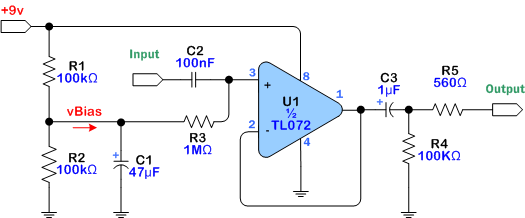
Well, someone's taken a few Pete Cornish pedals apart and here's the schematic for the buffer:
This is the classic pedal for that Beck/Gilmour tone. Build one - you won't be disappointed! Look - here's Jeff Beck with his:
Here's the Colorsound description:
"So what's the difference between the Power Boost and the Overdriver ?? Um . . . .nothing ! Except the case . The Power Boost was born in the late sixties - the idea was to give guitarists a boost . . . . . in power , and it did ! Guess it was just luck that when you turned the pedal up full it sounded like the best stack ever ! We we're really popular with glaziers in those days , windows were shattering right accross London ! Then the pedal was taken to the Dallas trade show where it was given a huge standing ovation ( like clapping - the guitars hadn't been invented yet ) and a bunch of flowers - you see the American market was ready for the sound but felt it looked a bit too . . . well . . .orange .
So , it was rehoused in a grey hammerite case , called the Overdriver , Jeff beck made 'Blow by Blow' with it , and the rest , as they say , is a mystery . . I mean history ! Recently I was lucky enough to be presented with three , unused Power Boosts circa 1968 - they we're still in their packing , never been sold - they sounded just great - just like a new one ! No kidding - I A/b tested the pedals old and new and blindfolded I couldn't tell the difference . . . well I could have felt for the master volume - we have added that - windows are expensive these days !"
And a demo video of the Powerboost/Overdriver in action:
Here's some gut shots:
And the schematics of the different variations there have been over the years:
"This is my Fuzz pedal. There are many others like it, but this one is mine. My Fuzz pedal is my best friend. It is my life. I must master it as I must master my life. Without me, my Fuzz pedal is useless. Without my Fuzz pedal, I am useless. I must play my Fuzz pedal true. I must play harder than my enemy, who is trying to outfuzz me. I must outfuzz him before he outfuzzes me. I will. Before God I swear this creed: my Fuzz pedal and myself are defenders of Rock 'n Roll, we are the masters of our enemy, we are the saviors of my life. So be it, until there is no enemy, but peace. Amen." - Fred Briggs, 19/02/2012.
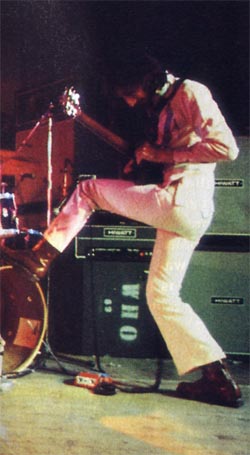
The Univox Superfuzz is an absolute classic - it's buzzsaw power fuzz tone has been employed by many of Rock's greatest guitarists. One of the best known users of the Superfuzz was Pete Townshend of The Who - he used it for that classic big box fuzz tone on his later records and was the reason his tone sounded so damn good on the "Live at Leeds" recording.
Here's some more info from thewho.net regarding Pete Townshends use of the Super Fuzz:
"The U-1093/U-1095 Univox Super-Fuzz fuzz pedal represents a key part of Pete Townshend’s classic stage sound. He used versions of the Univox Super-Fuzz between 1968 and 1978. You can hear the effect clearly in recordings from this era — the signature “buzz saw” sound during leads and rave-up outros.
Pete began using the Super-Fuzz in late 1968, likely November or December, with the first documented occasion being the Rolling Stones Rock and Roll Circus in Wembley on 11 Dec. 1968, which also represents Pete’s and John’s first known use of their Hiwatt-badged Sound City stacks.
He used the first version of the Univox Super-Fuzz, the metal grey version, on stage from late 1968 to mid- to late-1971, when he switched to the reddish-orange die-cast version with the large pedal surface. He used this version until 1978, where the last use of the pedal was 15 May 1978, at the Shepperton show filmed for The Kids Are Alright."
The circuit was designed in the late 1960s by the Japanese company Shin-ei, (who also produced another well known fuzz box, the Shin-ei Companion FY-2) and manufactured in Japan by Unicord. The first Super-Fuzzes were made in 1968, and production continued until the late 70s.
Design
The first units were made in a simple stamped sheet metal box, painted grey, with a blue Univox sticker on the top. Around 1970 production was changed to a die-cast metal box, with a large pedal featuring a rubber cover that had the words "Super-Fuzz" embossed on it. The first die cast units were either grey or black, with a green or black foot pedal. Around 1973 or so, they were all produced with an orange pedal, with a green or blue foot pedal. The later models also featured an internal trim pot for controlling the octave balance.
Alternative manufacturers
Although the Univox is the most well known incarnation of this circuit, Shin-ei licensed this circuit out to dozens of manufacturers, including Ibanez, Apollo, Companion, Shaftsbury, Mica, JAX, Kent, Teisco, Marlboro, Royal, and many others. With a slightly altered input stage, the circuit is identical to the Ibanez Standard Fuzz. Sometimes it was packaged with a wah pedal, or with the tone switch being a footswitch, or both. This circuit is also very similar to the famous Fender Blender and Roland Bee Baa. More recent applications of this circuit type can be found in Guyatone's TZ-2 Fuzz, MJM China Fuzz, Black Candy Superfuzz Deluxe, Prescription Electronics' OUTBOX, BOSS's FZ-2 HYPER Fuzz, and others, although most tend to agree the newer versions do not sound quite the same.
Sound
This unique fuzz tone is an octave fuzz using two germanium diodes to produce the square wave clipping. The controls are 'Balance' (volume), 'Expander' (fuzz amount), a two position 'tone' switch, and an on/off footswitch on top. There are two unique features of this device that set it apart from other distortion and fuzz pedals. The first is that the full-wave rectification of the circuit produces an upper octave as well as a slight lower octave. This also gives the sound a lot of compression and gives a mild ring modulator effect. The second unique feature is a tone switch that engages a 1khz filter that "scoops" the mids, giving a very fat, almost bassy tone, unique to this circuit.
Today, the Super-Fuzz is being manufactured under the name "Classic Fuzz" by Wattson Classic Electronics, which is in no way associated with Univox, Unicord, or any of the original companies that manufactured the Super-Fuzz. Other versions of the Super-Fuzz circuit are available from boutique companies like 73 Effects and Black Cat.
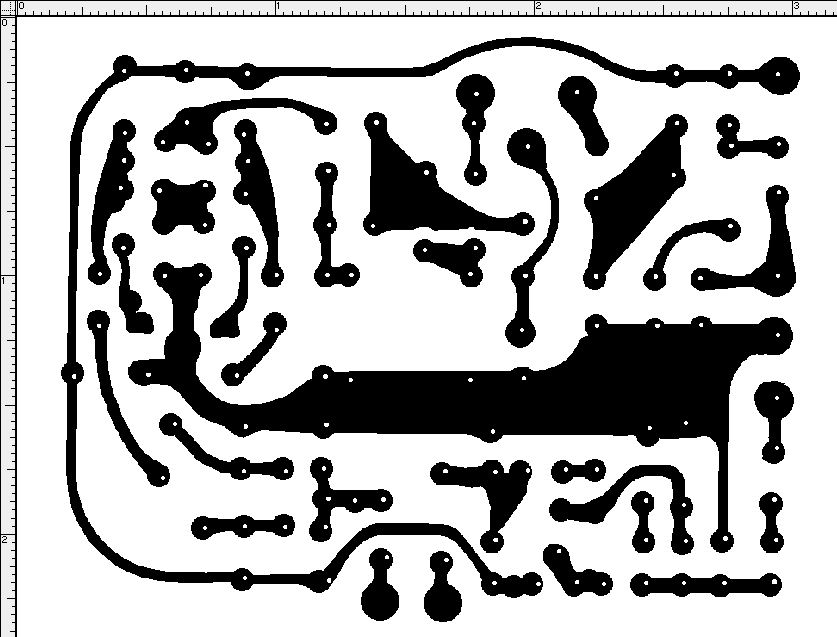
Alternately if you don't like PCBs here's a great vero from Mike Livesley:
Here's a great post from mictester that answers some common Super Fuzz questions:
"LucifersTrip wrote:
I finally got around to reading this killer thread...Excuse me if I missed it here somewhere, but I was just curious about a couple things I didn't come across that I was surprised wasn't discussed.
1) What would be a typical hfe of a 2SC539 and 2SC828 in an original Superfuzz?
(my guide shows 90-700 for the 2SC539 and 65-700 for the 2SC828, which is a large range)
- The 539 had a slightly better noise spec. The 828 seemed to be almost any old transistor that came off the line and they couldn't fit into any particular category! In my experience, the circuit works best with high hfe for the first two transistors and lower for the rest. I used BC109Cs for the first two transistors and then a CA3046 for the rest. Sounds really good!
LucifersTrip wrote:
2) Since there are 2 different transistors (2SC539 for Q1,4,5,6 and 2SC828 for Q2,3) used according to the schematic,
why does it seem everyone is subbing all the same transistors for Q1-Q6?
- The types aren't too critical, though it helps if the long-tailed pair are matched and the resistors around them are matched too - you get much more octave that way. Almost any silicon transistors will work well in this circuit!
LucifersTrip wrote:
3) Did anyone try any germanium subs (and re-bias) for any of the transistors?
- There's no point. It wouldn't sound much different, and it would be quite temperature sensitive. The biggest change you can get is by using silicon instead of germanium diodes for the clipper!"