Welcome to the Revolution

Hi there, welcome to my blog - La Revolution Deux. It's an odd name - but I like it! Here you will find all the info on my various DIY Guitar effects builds, amplifiers and guitars. Everything from a humble Ibanez tubescreamer to the holiest KLON Overdrive.

You may also find a few effects builds that I am looking to move on - usually in exchange for other effects/gear/cash. You can always check my ebay account to see what I've got up for grabs.

Have fun, enjoy the blog - Fred Briggs :-)

CONTACT ME


Feel free to get in contact with me about anything you see on this blog or with any general questions about guitars, amplifiers and effects, I'll be happy to answer! Just click the button above to email me directly or alternately my email address is fredbriggs2007 [at] googlemail [dot] com

Search This Blog

Showing posts with label Wah Wah. Show all posts

Tuesday, 10 July 2012

Mad Professor - Snow White Auto Wah


The Mad Professor Snow White Auto Wah is a cool little envelope filter. Designed by Bjorn of BJF effects it always was going to be a decent design. Check out the demo video to see what this ice-cool pedal can achieve:


Well, the tracers fund over at freestompboxes got a hold of one and thanks to the work of several forumites (abflacken, Ice-9 plus many others) there's a schematic available:


And a PCB layout by DimebuGG: http://www.mediafire.com/?wntjz1k5kj0jkjq

And a vero layout by Harald Sabro (www.sabrotone.com):


My7of9 (from http://www.guitarpcb.com), has made a great post detailing some mods/improvements that he has made to the circuit. I've summerised them here, along with the circuit block schematic he provided:


"Here are a couple Mods with an explanation from our site (GuitarPCB.com) which some really seem to favour.

Install a 1N34 germanium diode in D6 and a 1uf electrolytic cap for C8 and the thing really came alive.Sounds much funkier clean and before a light overdrive it cops a great Garcia-Like tone.

In Regards to adjusting R18 as well as much more here is the explanation.

R18 mod - short answer - increasing R18 will allow you to set the Sensitivity more towards the 12 o'clock position. I'd go with a 47kΩ resistor here. The only advantage is being able to turn the signal down a bit further (50% to 0% is better than 20% to 0%) at the expense of turning the signal up (20% to 100% is better than 50% to 100%)

The circuit can be broken down into five main blocks:

Input buffer stage (blue) a high impedance input to get as much guitar signal as possible going into the circuit and a low impedance output to drive the next two stages.

State variable filter (yellow). Without getting too techie, this is the part that goes "Wah". If you are interested, look at the application notes (Google NE5517 or LM13700 data sheet) - warning !! this can be rather boring for normal sane people.

While we need to keep the signal going into the State Variable Filter (yellow) quite low, a slightly higher level signal might be needed for the envelope follower stages (green, pink and lilac).

The "green" stage boosts the signal, the "pink" stage converts the signal into a DC voltage, the DC voltage is proportional to the signal coming from the "green" stage - higher signal level, higher DC voltage level.

The DC voltage output of the "pink" stage drives the transistors in the "lilac" stage into producing a control current (more DC voltage at the base of Q2 means more current), the control current, which is connected to pins 1 and 16, tells the State Variable Filter (yellow) how much it should "Wah".

Since the question is about R18, a quick look at the "green" stage might be in order.

Nothing more than a gain stage. The gain is determined by whatever the Sensitivity pot is set at divided by the value of R18.

If the pot is set to 50% rotation, the resistance value of the pot (for a 100kΩ linear pot) is 50kΩ. Divide 50kΩ by 20kΩ - the value of R18 - and you have a gain of 2.5. If the input signal is 100mV, the output signal is 250mV.

So how did I arrive at a value of 47kΩ in the short answer ?

It would appear from many posts that setting the Sensitivity pot at the 9 o'clock position gives good results.

Since "9 oclock" is about 20% rotation, the value of the Sensitivity pot will be about 20kΩ.

The gain is therefore pot value divided by R18 which is 20kΩ / 20kΩ giving a gain of 1.

If I set the pot to 50% rotation, the pot value is now 50kΩ and if I change R18 to 50kΩ (47kΩ nearest standard value), the gain is 50kΩ / 50kΩ which is also a gain of 1.

It is possible to leave the value of R18 as it is (20kΩ;) and change the pot to a 47kΩ pot and still achieve the same results.

There is one other mod possible - called "side chain" which allows you to place effects such as fuzz and distortion before the auto wah and achieve good results. The only disadvantages are that you will require a simple buffer / splitter circuit (if you have got a Tonmann ParaMix available from GuitarPCB.com you won't need the extra circuit) plus you will need enough space on the enclosure to install another jack socket."


Here's a nice internal picture of the Mad Professor Snow White Auto Wah:


Here, for reference is the freestompboxe.org topic: http://www.freestompboxes.org/viewtopic.php?f=7&t=7012

Friday, 6 July 2012

Vox - Clyde McCoy Wah

Jimi Hendrix's Clyde McCoy Wah which sold for over $11,000 at a recent auction.
Who is Clyde McCoy and why is this Wah pedal so sought after?

Good old wikipedia provides this info;

"Clyde McCoy was a jazz Trumpet player ... who developed a signature "wah-wah" sound in the late 1920s by fluttering a Harmon mute in the bell of his trumpet. In 1967, this distinctive sound was replicated for electric guitar with the introduction of the Vox Clyde McCoy Wah-Wah Pedal, the most significant guitar effect of its time. The Wah-wah pedal was invented by a young engineer named Brad Plunkett, who worked for the Thomas Organ Company, Vox/JMI’s U.S. counterpart. The wah circuit basically sprang from the 3-position midrange voicing function used on the Vox Super Beatle amplifier.

Vox cleverly packaged the circuit into an enclosure with a rocker pedal attached to the pot (which controlled the frequency of the resonant peak) and named the new device after Clyde McCoy. Early versions of the Clyde McCoy pedal featured an image of McCoy on the bottom panel, which soon gave way to his signature only before Thomas Organ changed the name of the pedal to Cry Baby. Thomas Organ’s failure to trademark the Cry Baby name soon led to the market being flooded with Cry Baby imitations from various parts of the world, including Italy, where the McCoy pedals were originally made."

Ok, so they were the first wah-wah pedals ever made but that doesn't explain why everyone wants one. Well, Jimi Hendrix, the man who is probably most associated with a wah pedal, used one - that's why everyone wants one.

The insides of the Clyde McCoy Wah.
Here's Hendrix on his Wah playing Voodoo Chile live at the Royal Albert Hall, probably one of the songs most associated with the use of a wah pedal and the reason the effect became so popular;


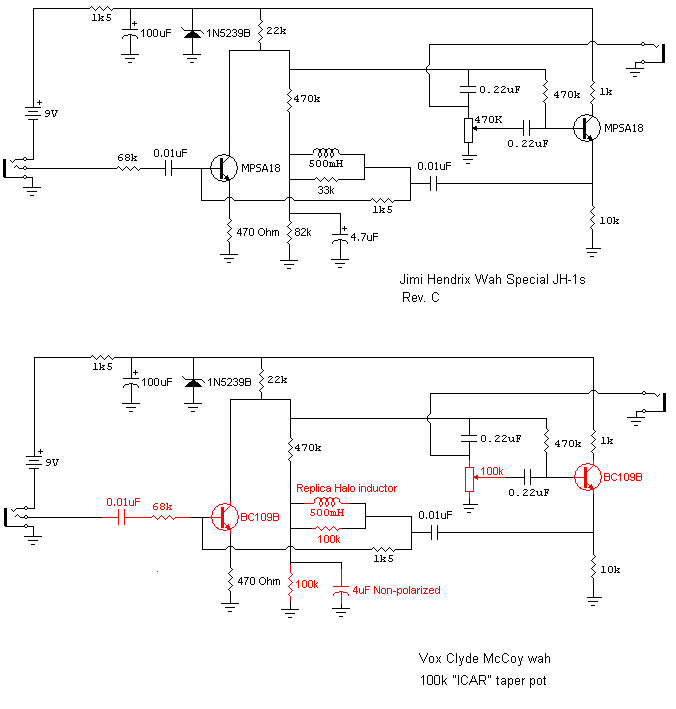
So, let's check out the schematic of the original Vox Clyde McCoy and compare it to the standard Cry Baby model (although it's noted as a Jimi Hendrix model it's just the same as a standard Cry Baby model) wah;


Ok, so there's not that much difference but it's a small circuit so small differences in components add up to make a large difference in sound. Firstly the transistors are BC109, these have a much lower HFE (gain) than the MPSA18 darlington type transistors used in the standard Cry Baby, this lower transistor gain leads to the wah having a much nicer and rounder bass response. The wah pot has an "ICAR" taper, these are vintage specs and replicas can be bought from various sources. The ICAR taper alters the feel of the wah and, as I find, gives you more quack on the toe end of the travel. Add together the other small differences in component values and you have the changes that make the McCoy wah unique.

Going back to the gutshot of the Clyde McCoy wah there are a few further things we need to take note of before we look to construct a replica;

  • The capacitors are old "tropical fish" style caps, many people believe these caps have their own sound and contribute to the character of the original Vox Clyde McCoy.
  • The wah inductor - it's known as a "Halo" style inductor (due to it's ring type shape). There are many people who build replicas of these inductors, one of the best comes from arteffect in Israel.
So, we want to build one now, you've got your old Cry Baby shell gutted and you're ready to build up the circuit. Here's what you need - a great vero layout from Sinner of turretboard.org;

Thursday, 15 March 2012

Fred Briggs - Wah Wah


Here's a Wah Wah I've built. It's based around the old Vox Wah (How can you tell!?) but it's got a few cool extras:

1) Input and output buffers so you can use it with all your stompboxes without it playing tricks on you.

2) Adjustable "Blend" control which allows you to blend in some clean signal with your Wah, this actually makes a real difference and allows you to wah wah away without completely Wahing out everything else you're trying to do. It's one of the best mods I've done to a Wah. You could in fact use the circuit I installed to run a "dry" signal FX loop which would then allow you to place more FX into the dry part of the blend circuit. Very cool but I haven't yet done that - this is enough for now!

3) Standard cap, inductor and resistor tuning to suit your own tastes!

Wednesday, 19 March 2008

Vsex Winkle Probe: Zvex Wah Probe


Zvex: Interesting FX... The "Probe" series that he runs has been a source of mystery for many moons - until now! Thanks to the Freestompboxes forum members (~arph and others!) who disemboweled their own probe controllers and donated them to the DIY world :-)

Here's a demo video if you've never seen one in action before:


Here is the schematic of the actual "Probe" controller, you can see that it is a series of inverters driving a simple LED driver - this LED driver is used to control an optocoupler (Also called a vactrol) which is basically a LED stuck to an LDR wrapped in black tubing. The LDR section is then used to control a parameter of an FX unit...


[Note - missing capacitor value at the base of the second transistor - 22nF]

Here is the schematic of the old Colorsound Wah pedal, inductorless as you can see. Zvex uses this circuit with a few mods in his Ohh-Wah, Seek-Wah and Wah-Probe FX.

All you need to do to build a Zvex Wah-Probe work-a-like would be to build up a Probe controller using the above schematic and connect it's control vactrol LDR in the position specified in the Wah schematic below!


There you have it, a proximity controlled wah-wah pedal - absolutely useless for that "cocked-wah" sound ;-)