Welcome to the Revolution

Hi there, welcome to my blog - La Revolution Deux. It's an odd name - but I like it! Here you will find all the info on my various DIY Guitar effects builds, amplifiers and guitars. Everything from a humble Ibanez tubescreamer to the holiest KLON Overdrive.

You may also find a few effects builds that I am looking to move on - usually in exchange for other effects/gear/cash. You can always check my ebay account to see what I've got up for grabs.

Have fun, enjoy the blog - Fred Briggs :-)

CONTACT ME


Feel free to get in contact with me about anything you see on this blog or with any general questions about guitars, amplifiers and effects, I'll be happy to answer! Just click the button above to email me directly or alternately my email address is fredbriggs2007 [at] googlemail [dot] com

Search This Blog

Showing posts with label Famous Pedalboards. Show all posts

Friday, 15 June 2012

John Frusciante - Red Hot Chilli Peppers

[This article has build details on the Boss CE-2, Ibanez WH-10 Wah and Marshall Shredmaster]


The Red Hot Chilli Peppers are a band renown for producing chart topping albums - Blood Sugar Sex Magik, Californication, By the Way and Stadium Arcadium all hit the top of the charts all over the world with all of them going multi platinum winning huge critical acclaim and commercial success.


However, there is a darker side to The Chilli Peppers, a band with a curse over it's guitarists; Hillel Slovak (dead - drug overdose), Dave Navaro (mad) and John Frusciante (drug addiction) have all had spells as the main axe man in the Chilli's before tragedy or troubles forced them to leave.
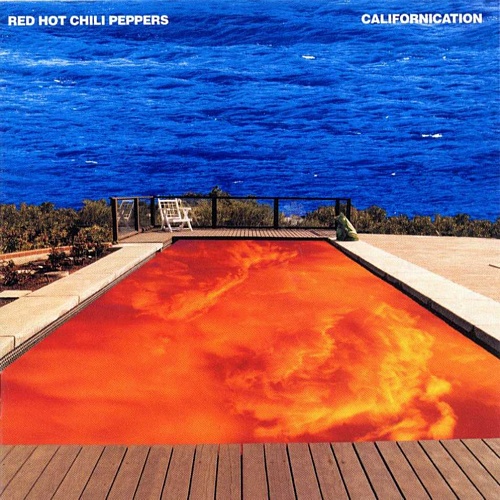
One of the best albums ever?
Although all of these guitarists left their own mark on the Peppers it is John Frusciante that is most well known and associated with the band as it was he who lent his guitar riffs and songwriting skills to the band in the era of their greatest success. Rolling Stone ranks him as #72 on their "100 Greatest Guitarists of all Time" and has this to say about his talent and style;

"The Red Hot Chili Peppers always knew how to rock a party; it took John Frusciante to turn them into an arena-packing band with a sound they could call their own. Frusciante is a remarkably elastic stylist and a gifted sculptural arranger who pushed the Chilis to explore new worlds without getting in the way of their funk-pumped energy; he beefed up their sound with both well-placed fire (the volcanic, Hendrix-style solo on "Dani California") and remarkable elegance (the indelible opening chords of "Under the Bridge")." [1]


So, apart from an exact understanding of the laws of funk and rhythm and supreme talent what makes John Frusciante sound like John Frusciante? What gear's in his locker and how can you replicate all those awesome tones yourself?

I'm going to be looking at his tones from around the 1999/Californication stage of his time with the band as that's my favourite album and also because after this time his set up becomes hugely complex, check out this image of his 2006 "Stadium Arcadium" tour setup [3];


Key;

1 - Moog Expression pedal
2 - MXR Micro Amp
3 - Electro-Harmonix Big Muff Pi USA
4 - Boss DS-2 TurboDistortion
5 - Mosrite FuzzRite
6 - Ibanez WH-10 Wah
7 - Electro-Harmonix Holy Grail Reverb
8 - Moog MF103 12-Stage Phaser
9 - Boss CE-1 Chorus Ensemble
10 - Moog CP-251 Control Processor
11 - Boss FV-50 Volume
12 - Line 6 DL4 Delay Modeler
13 - Electro-Harmonix Deluxe Electric Mistress
14 - DigiTech PDS 1002 Digital Delay
15 - Guyatone VT-X Tube Tremolo
16 - Line 6 FM4 Filter Modeler
17 - Moog MF-101 Low Pass Filter
18 - Moog MF-105B BassMuRF
19 - Moog MF-105 MuRF
20 - Moog MF-102 Ring Mod

And compare it to his much simpler Californication recording setup [3];


Key;

1 - Boss DS-2 TurboDistortion
2 - MXR Phase 90
3 - Boss FZ-3 Fuzz
4 - Ibanez WH-10 Wah
5 - Boss CE-1 Chorus Ensemble (x2)
6 - Boss DS-1 Distortion
7 - Electro-Harmonix 16 Second Delay
8 - Electro-Harmonix Micro Synthesizer
9 - ??
10 - Uni-Vibe Expression Pedal ?
11 - Dunlop Uni-Vibe UV1SC Stereo Chorus

Further more popping over to the guitargeek archives and checking out his stage setup from 2001 we can see that his go to gear was;

"Amps
Fender Dual Showman Silverface Head
Marshall 2550 Silver Jubilee Head
Marshall Major Head 


Cabinets

Marshall Cabinet / 4x12

Guitars

Fender Stratocaster American Electric Guitar 
Fender Telecaster American Electric Guitar 
Gretsch White Falcon Electric Guitar 

Pedals

Boss CE-1 Chorus Ensemble
Boss DS-2 Turbo Distortion
Electro-Harmonix Big Muff Pi Distortion USA 
Ibanez WH10 Wah 
MXR Phase 90 Phaser" [2]

Which was all set up and connected something like this [2];


Now, I should say that this article is not going to show you how to build guitars or amplifiers, just his pedal board, so we'll get the guitars and amps out of the way now - you'll need a Fender Strat type guitar, or at least something with single coil pickups, humbuckers are a real no-no for John's tone. You'll also want a decent amp, if you're on a budget go for something with two switchable channels - a clean and a crunch setting with a marshall-esqe voicing.

Now, moving onto the pedals. I've previously covered some of the pedals here in my Kurt Cobain article (The Boss DS-1 Distortion and Electro Harmonix Big Muff Pi) and here in my Jonny Greenwood article (MXR Phase 90, The Magnus Modulus Delay (for John's Delay tones)) so that leaves us to work out the Boss DS-2 Turbo Distortion, the Ibanez WH-10 Wah pedal, the Boss FZ-3 Fuzz and the Roland CE-1 Chorus Ensemble.

Firstly the Boss DS-2 Turbo Distortion;


And a video of how it sounds;


And a schematic;


Looks pretty complicated doesn't it? And it is. It's a design utilizing discrete opamps and a switchable boost and mid peaking filter, not something seen that often in pedal design. There aren't currently any project files out there for the Boss Turbo Distortion so it looks like if we want to build up this pedal board we're going to have to find something similar and go with that instead.

For this I'm going to recommend the Marshall Shredmaster Distortion pedal:


It's contour control allows you to get those ultra high gain "peaked" tones that you're looking for. Here's the PDF file for the Marshall Shredmaster build;


With the distortion requirements covered next up is his fuzz pedal - the Boss FZ-3;

And a demo video;


It's a pretty decent sound really, and that from Boss - not a company renown for it's Fuzz Box pedigree! There isn't a lot of info on the circuitry of the Bozz FZ-3 but here's an unverified Boss FZ-3 schematic from Dirk Hendrik;


Now, check that out - looks like a silicon Tone Bender. The silicon tonebender sounds great and will enable you to produce all the tones you'll need - so if you're looking for all those Boss FZ-3 tones and more build the Silicon Tone Bender project which you can find here.

Now - the Roland CE-1 Chorus Ensemble;

With a demo video;


The CE-1 really is a great chorus pedal but there are a few problems with it's design when using it with guitar;

1) It was designed for keyboard, meaning it's input impedance was way too low for standard guitar usage and caused significant loading issues in most setups.
2) It requires plugging directly into the mains, so there's no chance of it popping onto your board seamlessly.
3) It's f&*king massive!

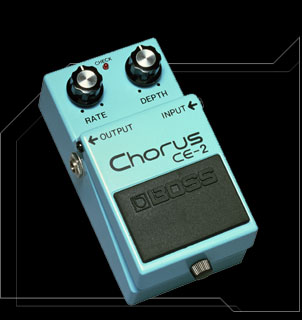
Now there is a schematic out there and I'll present it here for reference, I am, however, going to suggest a different build here - the Boss CE-2; the updated version of the CE-1 which was designed to work with guitar!

The Roland/Boss CE-1 Schematic
Here's the Boss CE-2;


And here's a great project file for it from Tonepad.com;  http://www.tonepad.com/getFile.asp?id=101 

It's worth noting that the MN series chips are now obsolete and tough (but not impossible) to find. If you do some digging you will find some around and they are worth it - the CE-2 is one of the best sounding analogue choruses I've ever heard and if you do manage to build one up it'll be a cherished part of your rig for a long time!

Finally we're going to need a Wah Wah, for all those wah soaked riffs and solos. The Ibanez WH-10 is regarded as a modern classic and is still popular now with the pedal currently in it's "V2" phase.


The WH-10 isn't like other more traditional Wah Wah pedals as it is "inductorless" (it doesn't require an inductor to do it's Wah Thing!) unlike, for example, the Dunlop Cry Baby which does. So, how does the WH-10 sound? Check this out;


Here's the schematic of the WH-10;


Here's the project file from the great Dirk Hendrik;


Give it a crack, the pot is just a standard linear 50kB. The project file is all lined up for use in a crybaby shell.

So that's it, your guide to John Frusciante's Californication tone, done!

Monday, 6 February 2012

Kurt Cobain - Nirvana Gear

[NOTE - This post includes projects for the BOSS DS-1, ProCo RAT, Electro Harmonix Big Muff Pi, the Electro Harmonix Small Clone Chorus and the Little Angel Chorus]

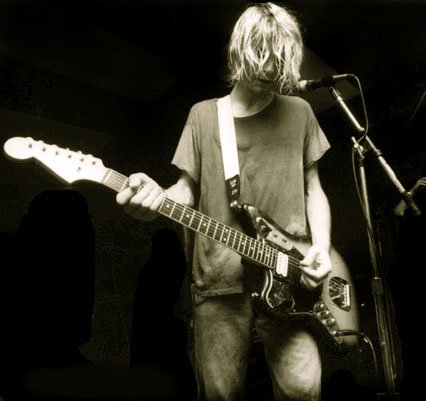
Kurt Cobain - arguably the last great Rock star. In 1991 Nirvana's Nevermind changed the face of guitar music for good. The sound was pretty much unstoppable with the aggressive roar of Kurt's overdriven tones softly complimented by the chorusy wobble and jangle of his clean licks. Kurt used a wide range of gear and it's nearly impossible to pinpoint exactly what gear he was using at what point during his career, however with a little research I've come up with a DIY guide to building your own Kurt Cobain pedalboard so you too can sound like the King of Grunge. The equipment I've chosen (FX pedals) were used mainly in Nirvana's Nevermind period...


Kurt used a range of guitars but by the time he came to record Nevermind he'd settled on the cheaper Fender models for his main sound; the Fender Mustang and Jaguar are now synonymous with Kurt but any guitar with a humbucker installed in the bridge position and a single coil elsewhere will be able to produce his tones.

His main preamp was a Mesa Boogie Studio .22, these were run into Crown Power Base 2 power amplifiers. Kurt used these to drive anything from a single stack to four 8x12 stacks (depending on the size of the venue). To get Kurt's tones you're going to at least need a closed back 4x12 cab, anything less and you just won't get the required air movement and low end thump. The preamp was set fairly clean, this allowed Kurt to use his distortion boxes to generate all of his signature aggressive distortion tones.

Here's an image of Kurt Cobain's stage rig from around 1992:


As you can see it's pretty simple - a BOSS DS-1 Distortion box into an Electro Harmonix Small Clone Chorus Pedal. However, it is also known that Kurt used a ProCo RAT and an Electro Harmonix Big Muff during the recording of Nevermind.

[One of the best album covers ever?]


In this guide I'm going to offer projects to build a BOSS DS-1 Distortion, a ProCo Rat and an Electro Harmonix Big Muff. I will also provide a project for the Electro Harmonix Small Clone but will also cover a project detailing the construction of a simpler Chorus circuit (some of the parts in the original Small Clone are now quite rare and hard to purchase).

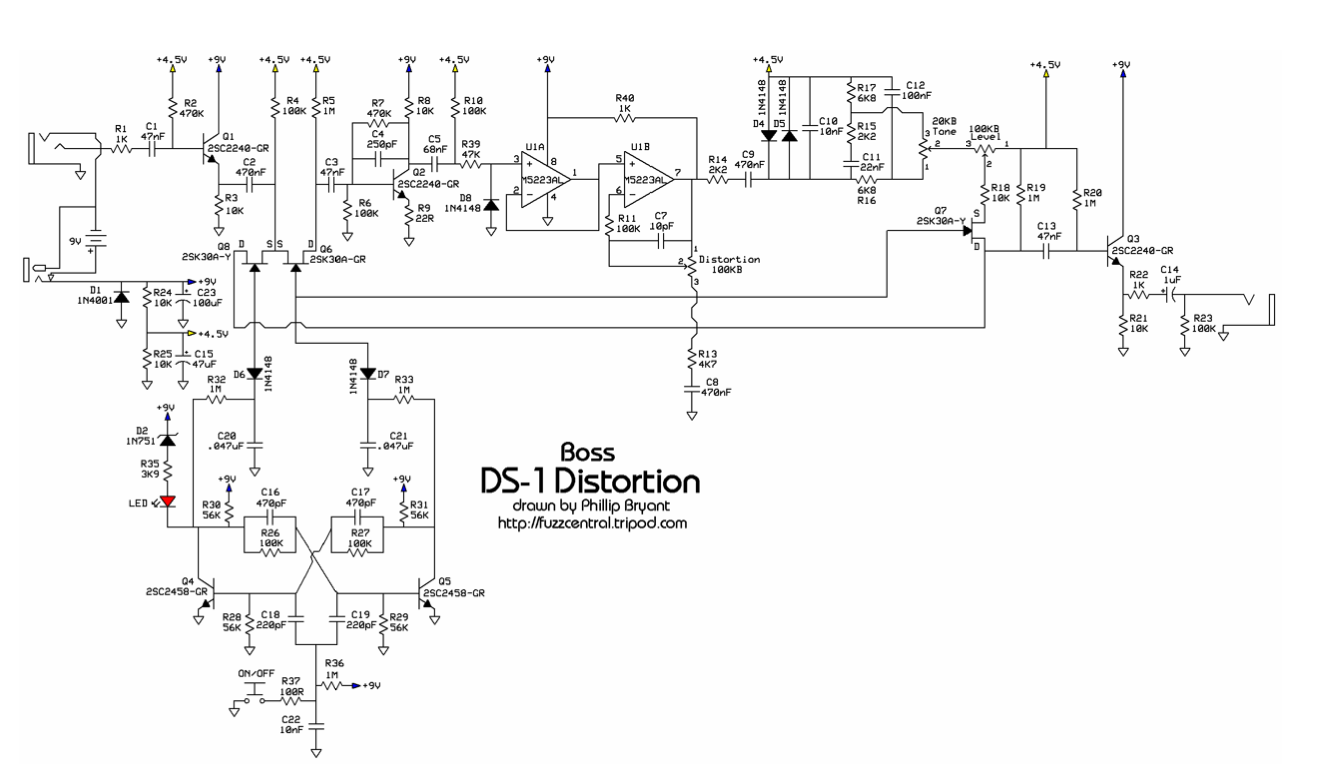
So, first up is the BOSS DS-1 Distortion:


It's an age old classic and produces that pronounced nasaly distortion and clipping which became Kurt's go to heavy tone. There's a great project for the BOSS DS-1 Distortion over at tonepad.com here: http://www.tonepad.com/getFile.asp?id=78

And here's a schematic for reference:

Next comes the ProCo RAT. Personally I like the RAT more than the DS-1, it's got a slightly more open tone and isn't as nasal:


Again there is a great project on the tonepad site, check it here: http://www.tonepad.com/getFile.asp?id=89

And a great schematic taken from a tracing of a RAT produced in 1986 (About the right era!):


A massive part of the RAT sound is the diode type. You can change the 1N4148 for anything really, I like red LEDs in mine, Mosfets setup as diode clippers also sound decent. For the Nirvana tone go with the 1N4148s.

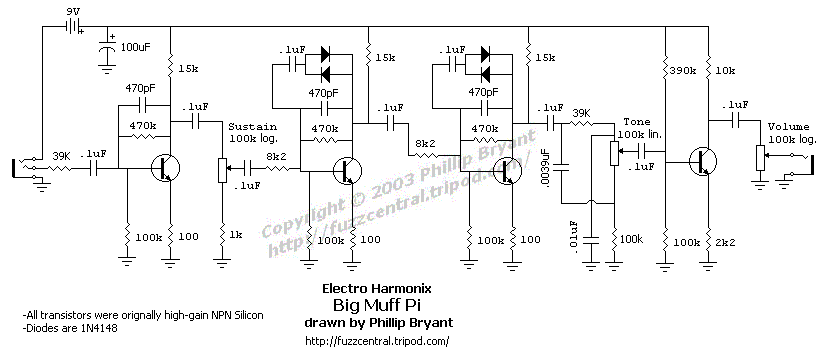
Next the Electro Harmonix Big Muff Pi. The Big Muff has been a firm favourite for distortion mongers since the 70s and it's one of my favourite pedals. It creates a smooth, compressed distortion sound like no other pedal I've heard before.


Once again we're off to tonepad.com for our project file: http://www.tonepad.com/getFile.asp?id=94

And a reference schematic:


Finally we're onto the choice of Chorus pedal. Kurt used his Electro Harmonix Small Clone chorus on nearly every record he made. Come As You Are gives you a great idea of the tones the pedal can create:


The Small Clone gives the guitar that watery almost liquid effect. Now the problem with building the Small Clone is the rarity of some of the parts, the key chip is the MN3007 which are now obsolete and very expensive. They are in stock at Banzai Music but cost over 8 euros a piece: http://www.banzaimusic.com/Delay-Chips-Clock-ICs/.

Once again tonepad hosts a great project file for the Small Clone, check it out here: http://www.tonepad.com/getFile.asp?id=97


I'm going to suggest something a little different though. The "Little Angel MKII" is a simple chorus circuit designed by Rick Holt and Mictester over at freestompboxes.org. It use the common and easily attainable PT2399 delay chip as it's heart. Here's the schematic, PCB transfer and PCB layout:


There is an even simpler version available that only uses a single dual op amp presented in the Little Angel thread on freestompboxes.org here: http://freestompboxes.org/viewtopic.php?f=13&t=10276

So there you go, put together your own Kurt Cobain / Nirvana pedal board! If you've got any questions, please email me or leave a comment :-)

Wednesday, 1 February 2012

Jonny Greenwood - Radiohead Gear

[NOTE - this post contains projects for the Marshall Shredmaster, BOSS SD-1, Demeter Tremulator/Fulltone Supa Trem, DOD 440 EF, MXR Phase 90 and the Magnus Modulus Delay]

Jonny Greenwood - guitar experimentalist supreme! Well, I've always been interested in how he made all those cool guitar sounds that he layered on the classic albums "The Bends (1995)" and "OK Computer (1997)". Well, I've done a bit of research and I've decided to put together the DIYers guide to building your own Jonny Greenwood-esqe pedal board. So what gear did he use around that time? With a bit of digging around the internet here's what I've come up with:

Amps
Fender Deluxe 85 Combo / 1x12 (Used for overdriven tones - note this amp is SOLID STATE!)
Vox AC30/6TB Top Boost Combo Reissue / 2x12 (Used for clean tones)

Guitars
Fender Starcaster Electric Guitar
Fender Telecaster Plus Electric Guitar (Custom cut off switch with Lace Sensor pickups)

Pedals
Boss FV-300H Volume Pedal
Boss LS-2 Line Selector / Loop / Power Supply 
Boss RV-3 Reverb Delay
Boss SD-1 Super Overdrive 
Boss TU-12H Chromatic Tuner 
Digitech WH-1 Whammy Original 
DOD 440 Envelope Filter 
Electro-Harmonix Small Stone Phaser USA 
Marshall Shredmaster Overdrive / Distortion
Proco RAT Distortion Pedal
Demeter Tremulator Tremolo
AKAI Headrush Delay Loop Pedal

Rack
Mutronics Mutator Filter / Envelope Follower 
Roland RE-201 Space Echo Tape Delay / Reverb

Here's a few images of his pedal board (A little later on than '95-'97 I believe):


And here's an image of Greenwood's stage rig cira 1997 (3):


So there you go - we've seen his rig, now how do we put it together? What order do we go for and what can we build and what should we just give up on and buy?

Looking at the task realistically we can DIY a fair portion of his pedalboard; we're gonna need the Marshall Shreadmaster or the ProCo Rat for those over the top distortion tones Greenwood favours, we can DIY a Boss SD-1 (A basic a Tubescreamer derivative) and also a decent Tremolo unit, the DOD 440 Envelope Filter won't be a problem either, the Small Stone Phaser is can also be DIY built (but I'm probably going to go for something a little different here). Obviously we're not going to even attempt a DIY build for the Digitech Whammy, The Boss Digital Reverb, the Roland Space Echo or the Mutronics Mutator*. So what can we do to replace the effects we can't DIY - well, we'll find work-a-likes, something that will get us as close a possible sound or I suggest cheaper more readily available alternatives that you can purchase...

Here is what I'm going to suggest as the DIY solution to Jonny Greenwoods setup:

Marshall Shredmaster, Boss SD-1, Volume Pedal, A/B Switch/FX Loop, Demeter Tremulator Tremolo, DOD 440 Envelope Filter, MXR Phase 9, DIY Magnus Modulus Delay...

That means if you're really wanting to go for the full Jonny Greenwood setup you're going to have to buy at least the Whammy pedal, a Reverb Pedal and a Volume Pedal. Here are some links to the cheapest available on amazon:


For the guitar you're going to need a single coil equipped guitar, a telecaster for authenticity if that's what you're after. Installing a kill switch a-la Jonny is pretty simple:


Regarding amplifiers you could go for the dual amp setup utilizing a simple A/B line switcher or you could use a single amp with some of the effects placed in a FX Loop switcher, the choice is yours. In this article I'm going to detail the dual amplifier approach. So, without any more delays; on with the builds!

Distortion - Marshall Shredmaster

So first up - the Marshall Shredmaster:


And here's an idea of what it sounds like in Jonny's hands. Take a listen to this:


It's a pretty killer high gain sound. Here's the schematic, pcb transfer and layout:


Overdrive - BOSS SD-1 Super Overdrive

Now we move onto the Boss SD-1 Super Overdrive:


Basically we need to build up a tubescreamer circuit with a few subsituted values. Here's the SD-1 schematic:

And a PCB layout for the classic tubescreamer, when you see the pdf file you can see it includes the parts substitutions needed for the Boss SD-1 (4): http://www.box.com/s/x60qzuje77mouj5xcbve

A/B Line switcher

An A/B Line switcher is a very simple piece of equipment that allows you to switch your input signal between two seperate outputs. The BOSS Line Selector is doing this job in Jonny's setup but we can make a much cheaper/simpler design by following the project file available at tonepad.com: http://www.tonepad.com/getFileInfo.asp?id=107

Tremolo - Demeter Tremulator

Now for the tremolo. It's been well documented that Jonny used a Demeter Tremulator:


Here's what he managed to create with that classic tremolo sound (I love this song!):


So how do we build one? Well here's the schematic, pcb transfer and layout:


As you can see the layout also offers the option to build up a Fulltone Supa-Trem which is just a copy of the Tremulator with a few mods....

Envelope Filter - DOD 440 EF

Now we move onto the envelope filter, Jonny is reported to have used the DOD 440 Envelope Filter:


These are fairly simple circuits and easy to build. In fact there is a full project already available on the GeneralGuitarGadgets website here: http://www.generalguitargadgets.com/projects/19-filters-envelope/119-dod-440-envelope-filter, I can fully recommend GGG, their service is excellent and they've been around for years. JD Sleep knows what he's doing!

Here's a little demo of the DOD 440 in action (it's actually the project from GGG):


Phaser - MXR Phase 90
So Jonny originally used the Electro Harmonix Small Stone Phaser, I'm going to suggest building something a little different. Main dual to the complexity of the Small Stone and the rare nature of the parts (CA3080 chips!). The MXR Phase 90 is a very popular phase pedal used by many famous artists over the years (Eddie Van Halen, Matt Bellamy of Muse and Tom Morello of Rage Against the Machine) and is relatively simple to build. Tonepad.com has a brilliant PDF Project file for the MXR Phase 90 here: http://www.tonepad.com/getFileInfo.asp?id=42

Now, you'll notice you need to use matched Jfets for the build, here's some info on performing the matching (From the great R.G Keen): http://www.geofex.com/article_folders/fetmatch/fetmatch.htm

Delay / Modulation Pedal - Magnus Modulus

For the delay pedal/space echo substitute I'd recommend building one of these:


It's the Magnus Modulus delay circuit designed by Forced_Fire pedals. It not only offers the standard straight delay options but full modulation of the delay line so you can garner chorus, vibrato and the standard "tape flutter" effects seen in the original Roland Space Echo. It also has the capacity to do the self oscillation effects heard on many Radiohead tracks. Here's the schematic, PCB transfer and PCB Layout files:


Pedalboard Signal Routing:

Ok, so now we've built all our FX and bought the ones we can't build. How the heck do we order them on our pedal board. Here's a quick hand drawn diagram of how you can do this:


So you've probably worked out that you're going to need a fairly large power supply to handle all those FX. You can see below there's an Amazon link to some decent quality DC Pedal Power Supplies:


OK, so that's about it. If you have any questions or comments please either email me or leave a comment at the bottom of this article :-) I hope you enjoyed it!

Briggs!

*(although there is an option to build a "work-a-like" of the Mutronics Mutator. The Oakley Filter Box was designed in 1997, a schematic is available here: http://www.emusic-diy.org/Schematics/Oakley/FilterBox, I'd only attempt to take this build on if you're an absolute pro - that thing is complex!)

References:
1) - http://www.greenplastic.com/coldstorage/gear/jonny.php
2) - http://en.wikipedia.org/wiki/Jonny_Greenwood#Equipment
3) - http://vintage.guitargeek.com/rigview/510/
4) - http://www.tonepad.com