Welcome to the Revolution

Hi there, welcome to my blog - La Revolution Deux. It's an odd name - but I like it! Here you will find all the info on my various DIY Guitar effects builds, amplifiers and guitars. Everything from a humble Ibanez tubescreamer to the holiest KLON Overdrive.

You may also find a few effects builds that I am looking to move on - usually in exchange for other effects/gear/cash. You can always check my ebay account to see what I've got up for grabs.

Have fun, enjoy the blog - Fred Briggs :-)

CONTACT ME


Feel free to get in contact with me about anything you see on this blog or with any general questions about guitars, amplifiers and effects, I'll be happy to answer! Just click the button above to email me directly or alternately my email address is fredbriggs2007 [at] googlemail [dot] com

Search This Blog

Saturday, 30 June 2012

Diamond - Compressor

[This post contains information on the Diamond Compressor & Fred Briggs Diamante]

Diamond make some real high-end stuff; the Memory Lane Delay, Halo Chorus and J-Drive are all top level (expensive!) pedals. My overall choice from the Diamond pedal range is the Diamond Compressor though. It gives a nice compression effect, not the super transparent kind, you can feel the squish but it's not over powering and the "tilt" EQ is a nice addition too allowing you to gently shape your overall tone. Ok, so it's a great sounding compressor and has loads of great features, but my favourite bit; the LED that changes colour with the compression level! Ha.

Here's a description from the Diamond website;

"Recording studios often use rackmount 'vocal channels' - a mic preamp, compressor, and EQ all in one unit as a front end for vocal recording.
The Diamond Compressor is our take on a 'guitar channel' - a dynamics and tone shaping tool for live and studio use - with low-noise, ultra-linear signal buffering, smooth opto-based compression, and a versatile 'tilt' EQ that musically shifts overall frequency balance. All in a user-friendly 3-control package - just Comp, EQ and Volume.

Features:

- Vactrol opto-isolator variable resistance path as used in high-end studio compressors for smooth attack and decay characteristics while preserving initial signal transients.


- Premium audio components, including 2% polypropylene capacitors,1% metal film resistors and a pro audio grade  opamp (our signal path opamp alone costs 8 to 10 times
what the industry norm uses).

- Post-compressor 'tilt' EQ provides a very musical tailoring of frequency response - seamlessly transition from a darker jazz voicing to a brighter jangle, with flat frequency response at the center detent position.
- Double filtering stage in side chain to eliminate low frequency modulation while preserving fast compression response.
- Dual AC capacitive coupling paths for improved transient response.

- Bi-color LED provides visual indication of depth of compression.


- True bypass signal path.


- Battery or standard negative tip 9V DC adapter operation, can be powered from 9 to 24 V negative tip."


Here's the ProGuitarShop video;


Now here's a gutshot (also from the Diamond website);


And, thanks to some incredible work by WhiteKeyHole, a schematic;


So, interesting parts of the design - the Tilt EQ is taken from an early 70s stereo preamp designed by Quad Ltd, it gently tilts the eq around 900Hz simultaneously boosting treble and cutting bass and vice versa (mid position is a flat response). It's a great tool for smoothing out EQ ranges and matching various pedals up to one another without sounding too drastic and overpowering other pedal's tonal characteristics. Another addition not normally seen in stompbox design is the current source that has been added to the emitter follower buffer stages. The addition of the current source to these stages reduces the THD (Total Harmonic Distortion) from 0.01% to 0.001% - not something you're really going to hear in a guitar orientated world! Those paralleled capacitors too - not really necessary!

Here's a closer look at the Tilt control schematic;

And a graph of the EQ response curve (note the phase inversion of the signal at extreme settings of the control);


After looking at the Tilt EQ schematic you'll notice that the bypass resistors R13 & R14 have been left in the Diamond design even though they are not needed, you could in fact remove them and not notice a difference.

Parts List;

Capacitors 
NOTE - C33 on the schematic is C32 on this parts list.
Caps 2u2 and higher are electrolytic. C22/23/30/31/32 are ceramic, all other film
C1 47u
C2 47u
C3 47u
C4 5n6
C5 5n6
C6 330n
C7 100n
C8 100n
C9 100p
C10 820p
C11 100p
C12 820p
C13 1u
C14 100p
C15 330n
C16 820p
C17 820p
C18 100n
C19 10n
C20 10n
C21 2u2
C22 100n
C23 100n
C24 820p
C25 3n3
C26 15n
C27 10n
C28 4u7
C29 3n3
C30 100n
C31 100n
C32 100n

Resistors
All metal film 1% except R1 which is carbon film 5%
R1 100R
R2 10K
R3 10K
R4 100R
R5 15K
R6 3.32K
R7 22.1K
R9 15K
R10 47.5K
R11 47.5K
R12 47.5K
R13 47.5K
R15 1M
R16 475R
R17 475K
R18 475K
R19 3.32K
R20 6.41K
R22 100R
R23 475K
R24 22.1K
R25 100K
R26 1K
R27 3.32K
R28 475R
R29 221K
R30 475K
R31 100K
R32 221K
R33 100K
R34 475K
R35 221K
R36 10K
R37 1.5K
R38 10K
R39 Jumper
R40 10K


Transistors are standard NPN/PNP medium gain
LED is a Tri-colour type.


For those after a layout to build this thing check out Harald Sabro's great layout here; http://www.sabrotone.com/?attachment_id=2157

Here's the freestompboxes.org forum topic; http://freestompboxes.org/viewtopic.php?f=7&t=850

Now, I previously mentioned that the Diamond has many superfluous parts and circuit structures so I decided to simplify it right down. Here's what I came up with;


Basically it's the same circuit as the Diamond just as simple as it can be; the buffers have been removed or simplified and the EQ section has been removed completely leaving controls only for "Compression" and "Volume".

Thursday, 28 June 2012

Devi Ever - Console Kickstarter!?


Remember your old Nintendos and SEGAs? Well this is a rebirth of the old "cartridge" based systems but this time it won't be Super Mario you'll be booting up - it'll be some killer fuzz tones. Devi's been working on this one for some time so if you're intrested get over to the kickstarter page and get involved; http://www.kickstarter.com/projects/deviever/console-ii-cartridge-based-multi-fx-guitar-pedal

Tuesday, 26 June 2012

Rothwell - Love Squeeze Compressor


"Designed and Built in Britain"; the mark of quality and the Rothwell Love Squeeze doesn't disappoint - it's a great hand built compressor pedal with an interesting design.

Here's the description from the Rothwell website;

"The Love Squeeze is a compressor designed simply to sound right with guitars, without any bizarre “pumping” effects and without any noise.

This has been achieved by designing a circuit from scratch instead of adopting the more common approach of using an operational transconductance amplifier (for tech heads, it’s usually the CA3080 chip) or simply copying an existing design (like some American boutique makers have done) and gives the Love Squeeze a sound of its own. Low level signals can be raised by as much as 20dB without boosting high level signals, so when used in front of distortion - either in a pedal or an amp - leads lines can be fattened up without chords sending the distortion into mush.

When used with a clean sound the Love Squeeze can be set to just take off the ice-pick attack of single coil pickups for a tone a little easier on the ear. Like reverb (when used sensibly), this is a subtle effect which can go almost unnoticed until it is switched off - then you wonder how you could live without it."

Here's the ProGuitarShop demo of the Rothwell Love Squeeze in action;


And another (with the Rothwell and Keeley Compressor);


Now, check out some gut shots - notice the high quality PCBs, neat wiring and general high standard of construction throughout :-) An all round decent piece of work!


Here's a schematic drawn up by ever productive WhiteKeyHole;


It's an interesting concept and a nice simple design. The use of a FET as a voltage controlled resistor makes the attack nice and quick and cuts out the cost of an expensive LDR. If I were to compare the tone of this thing to anything else out there it would be the old traditional Orange Squeezer - it's subtle and transparent compression, it doesn't pump and breath a'la OTA designs or higher ratio optical compressors. Overall I'd say it's a very nice little "tone tidier" compressor.

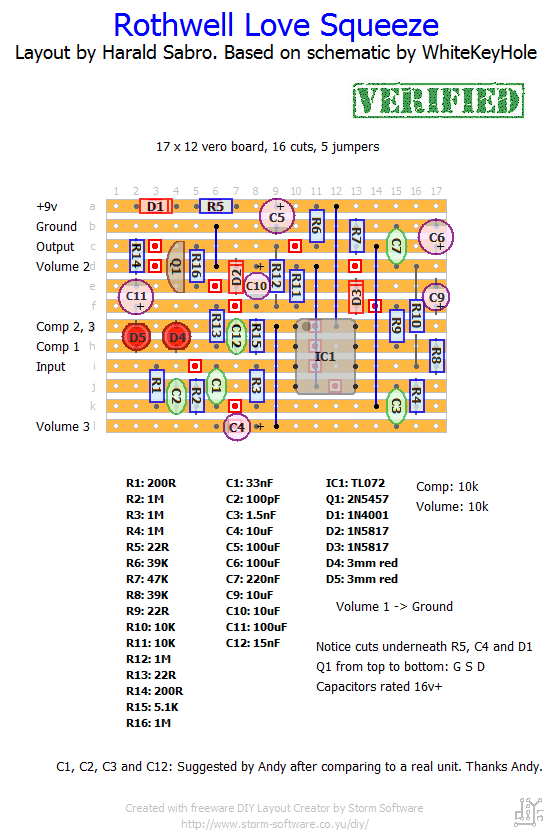
For those who want to build this thing here's a vero layout from the fantastic Harald Sabro; http://www.sabrotone.com/wp-content/uploads/2011/09/LoveSqueeze.gif

Sunday, 24 June 2012

TC Electronics - Sustain + Parametric Equalizer


This is a strange one, a super rare beast, but I had the opportunity to play with one the other day. The controls are a little tweaky and it's also sensitive to the position it's placed in the signal chain but when you get it right! Wooo, there's some great tones here; super long sustain and really punchy rhythm tones and with the parametric EQ you can really pick out certain frequencies that you want to accentuate or remove.

Personally the compression/sustain/noise gate part of this pedal is the one that I like, the parametric eq can be covered by other pedals but the sustain/noise gate section really is something unique. Flicking the distortion switch on gives you some nice clipped tones that add a nice smoothness to your tone.

There is very little info around the internet for these things and even TC Electronics struggle to provide info. I did discover that David Gilmour used a couple in his rig in the late 1980s though; http://www.gilmourish.com/?page_id=2111

Ok, so here's the description from the TC Electronics website (This description was in place for the reissue version that is also now discontinued!);

"One of the true grails of vintage effects pedals. This one really enhances your tone. Go from subtle compression to extreme sustaining effects at the tweak of a knob. This sustainer will prolong life of even your weakest tone otherwise destined for premature death.

The Classic Sustainer + Parametric EQ gives you studio quality compression in a pedal. Crank it to the extreme and it’ll give your sound that percussive “thud” brilliant for funk or country. And with its parametric EQ you’re in full control of which frequencies to target."


After even more searching I uncovered some gutshots of the pedal, check out the goofy 1980s PCB design;


After some more exhaustive searching and a trip to the WayBackMachine I discovered this;


Yes! A schematic file for the pedal. I'm going to have to study this one for a while until I really understand what is actually going on fully in the noise gate/compression section of the pedal but it's a pretty interesting design incorporating both OTAs *and* op amps in various feedback loop configurations. I'm probably going to have a play around with this design and see if I can distil the compression section into a little project for people to build up.

Friday, 22 June 2012

Fender Tweed "Deluxe" - Model 5E3


The Fender Tweed Deluxe has been with us for over 60 years now and it's popularity is still growing. First produced in 1948 as the Model 5B3 it is the mid 50s 5E3 circuit that guitar player claim is the greatest revision of the classic Tweed formula. 

Originally viewed as an "entry level" model the Tweed Deluxe has become one of the most recorded and iconic guitar amps of all time. It's sweet breakup and touch sensitive nature really allow the guitarist to feel like they are truly in control of the circuitry with every tone required available from slight alterations in pick attack or the guitar volume control.

If, somehow, you've never heard a Fender Tweed in action here's a demo video;


And another of a clone in action;


So, let's have a look at the schematic;


Super simple for a push-pull amp. All there is is two cascaded preamp stages a super simple "Cathodyne" phase inverter and a cathode biased push-pull power stage. The power supply is pretty poorly regulated and combined with the valve rectification isn't exactly what amp designers would call "Stiff". It's this simplicity combined with an errant luck of design that make the 5E3 the legendary amp it is. Below is the original layout as used in the actual amps themselves;


And here's the Ceriatone layout (based on the original layout but a bit easier to read;


For a full project pdf file with schematics and layout files (and a few mods!) check this out;


Here's a great site with loads of discussion on Tweed builds/mods and tones. There's some great demos too; http://www.recproaudio.com/diy_pro_audio/tweed_deluxe.htm